Top photo: a black curly-coated dog in a grey collar lying on a floor. Photo: KANABAIS / Wikimedia Commons, Public domain (cropped, resized and converted to WebP).
If you are looking for the best dog collar with name, this comprehensive guide covers everything you need to know. Whether you are a first-time pet owner or an experienced one looking to upgrade, you will find practical advice, safety tips, and honest comparisons below.
Quick Answer: What Should You Know About Dog Collar With Name?
Choosing dog collar with name well comes down to four things: matching the product to your pet's size and daily routine, checking the materials against how hard it will be used, setting it up or fitting it correctly, and inspecting it on a schedule. This guide covers each of those, plus the mistakes owners most often make.
Why Fit and Hardware Matter More Than Looks on Dog Collar With Name?
Answer: A collar does three jobs at once. It carries identification, it gives you something to hold when a door opens unexpectedly, and on most dogs it is the anchor the lead clips to. Pattern and color decide none of those. Webbing strength, buckle type and the stitching around the D-ring decide all of them.
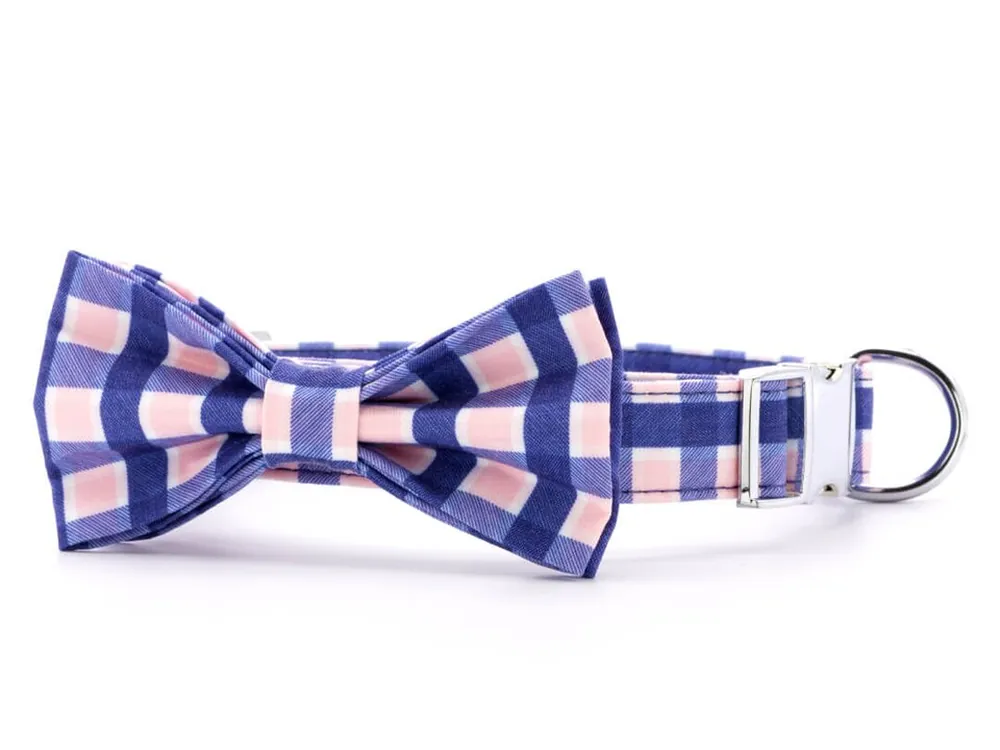
Photo: Mcbzen / Wikimedia Commons, CC BY-SA 4.0
A collar does three jobs at once. It carries identification, it gives you something to hold when a door opens unexpectedly, and on most dogs it is the anchor the lead clips to. Pattern and color decide none of those. Webbing strength, buckle type and the stitching around the D-ring decide all of them.
The failure that matters is almost never the strap snapping in half. It is the slider creeping open on a dog that backs up, a plastic buckle splitting in freezing weather, or a D-ring tearing out of a single row of stitching the first time a squirrel crosses the path. Each of those ends the same way, with a loose dog and a lead in your hand.
Comfort is the other half, and it is much quieter. Something slightly too tight rubs a line through the coat and leaves a thin bald patch under the chin that owners usually blame on food or allergies. Something too loose slides forward until it sits behind the ears, where a determined dog can back straight out of it. Neither shows up on the day you buy. Both show up after weeks of daily wear, which is why a fit check belongs in your routine and not only in the first week.
Buying well is mostly a matter of deciding what the strap is for before you look at colors. A house collar that only carries a tag can be light and soft. A walking collar for a dog that lunges at bicycles is a load-bearing piece of equipment and should be chosen the way you would choose a climbing sling, by looking at the parts that take the force.
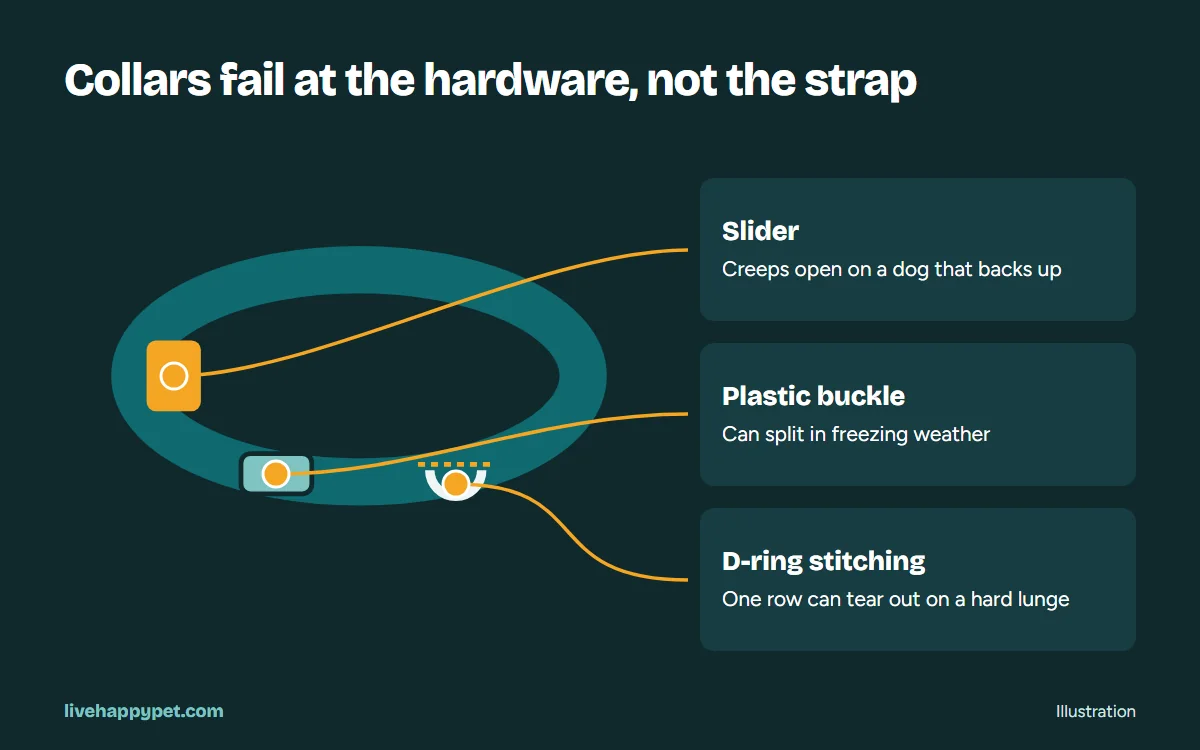
Illustration: Livehappypet
What Should Pet Owners Know About Different Types of Dog Collar With Name and When to Use Each?
Answer: Five styles cover almost everything sold: flat nylon webbing, coated webbing sold under names like BioThane, leather, padded or neoprene-lined straps, and the limited-slip martingale. A sixth, the metal chain that tightens with no stop, is a correction tool rather than an everyday collar and is not what most shoppers are after.
Five styles cover almost everything sold: flat nylon webbing, coated webbing sold under names like BioThane, leather, padded or neoprene-lined straps, and the limited-slip martingale. A sixth, the metal chain that tightens with no stop, is a correction tool rather than an everyday collar and is not what most shoppers are after.
For more expert recommendations, check out our leash guide.
Flat nylon webbing is the default for good reason. It is light, it comes in every width, it dries reasonably fast, and the good ones are woven tightly enough that the edges do not fuzz after a month. It is also the cheapest thing to get wrong: loosely woven nylon goes furry at the slider, holds smell, and frays at the buckle slot long before the buckle itself gives up.
Coated webbing is a nylon or polyester core sealed in a flexible plastic skin. It is the honest answer for a dog that swims, works in mud, or lives somewhere wet, because it rinses clean under a tap, does not absorb water or smell, and stays flexible in cold. It costs more, it is slightly heavier, and it has no give, so fit has to be right rather than nearly right.
Leather is the opposite trade. A full-grain strap softens to the shape of the neck, ages well, and looks better every year if it stays mostly dry. Repeated soakings dry it out and crack it, and nobody should be machine-washing it. Look at the edge: a quality strap is skived, burnished and stitched, while a cheap one is cut square and starts peeling in layers.
Padded and neoprene-lined straps exist for short-coated and thin-skinned dogs that chafe, and for broad necks where a narrow band digs in. The lining makes the collar thicker, which small dogs can find bulky. The martingale is a loop of webbing with a shorter secondary loop that tightens to a preset limit and then stops, so a narrow-headed dog cannot back out of it. It is a containment design, not a correction design, and it should never be left on an unattended dog because the loop can snag.
What Should Pet Owners Know About Materials, Buckles and D-Rings Used on Dog Collar With Name?
Answer: Two choices decide whether a collar holds: the buckle and the D-ring. A side-release plastic buckle is quick and fine for a dog that walks politely. A metal pin buckle, the kind on a belt, has no catch to split and is the safer choice for a strong dog. The D-ring matters just as much.
Two choices decide whether a collar holds: the buckle and the D-ring. A side-release plastic buckle is quick and fine for a dog that walks politely. A metal pin buckle, the kind on a belt, has no catch to split and is the safer choice for a strong dog. The D-ring matters just as much.
Side-release buckles are made from acetal or a cheaper generic plastic, and you cannot tell them apart by looking. What you can do is squeeze the arms and listen. A good one clicks crisply, releases cleanly, and flexes without creaking. A poor one feels gritty, and it is the part that shatters when a big dog hits the end of the lead in cold weather. Some makers hedge by fitting a metal side-release buckle, which gives you the speed of a clip with the strength of metal.
A pin buckle has one genuine drawback and one hidden benefit. The drawback is that it is slower, and you have to take it over the head or thread it every time. The benefit is that the adjustment is fixed, so it cannot creep: a sliding plastic adjuster on a side-release collar works loose over weeks of a dog pulling against it, and most owners never notice until the collar is two holes too big.
The D-ring is the piece that actually fails, and the clue is how it is attached. Look for a welded ring, closed all the way around, held in a folded tab of webbing or leather that is sewn with a box stitch or a bar tack. A ring that is merely bent to shape can be pulled open. A ring held by one straight row of stitching across the strap will tear that row out. On a collar that carries both a lead and tags, the best arrangement is a load-bearing D-ring for the lead and a separate small ring or split ring for the identification, so the tags do not take the shock.
Thread and edges finish the picture. Bonded nylon or polyester thread survives sun and abrasion far longer than cotton. Webbing cut with a hot knife seals its own edge and will not unravel; webbing cut cold starts shedding fibers at the first wash. None of this is visible in a product photograph, which is why the honest test is to run the collar through your hands when it arrives and return it if the edges are already rough.
How to Measure a Neck and Fit Dog Collar With Name?
Answer: Measure where the collar will actually sit, low on the neck just above the shoulders, using a soft tape or a strip of string held against a ruler afterwards. Then add room for two fingers laid flat against the neck. That gap is the entire fitting rule, and you check it with fingers.
Measure where the collar will actually sit, low on the neck just above the shoulders, using a soft tape or a strip of string held against a ruler afterwards. Then add room for two fingers laid flat against the neck. That gap is the entire fitting rule, and you check it with fingers.
You might also find our collars article helpful when shopping.
Buy by that measurement, not by breed. Two dogs of the same breed and the same weight can be a full size apart at the neck, and the chart on a product page is a guess made by somebody who has never met your dog. When the measurement lands between two sizes, take the larger one if it still closes to a two-finger fit at its tightest setting, because a collar that is already at the end of its range has nowhere to go.
Width is a comfort decision rather than a strength one. A narrow band concentrates force on a small area, so broad-necked and heavier dogs are more comfortable in a wider strap, while a wide strap on a small dog jams under the jaw and stops the head turning. Thickness matters for the same reason: a stiff, thick strap that is fine on a Labrador will stand away from the neck of a whippet and rub.
Then keep checking. Puppies need the fit tested every week or so while they are growing, because a collar goes from correct to dangerous faster than anyone expects. Adult dogs need it rechecked after a clip or a heavy shed, when the coat that was filling the gap disappears overnight, and after any real change in weight. Sighthounds, bull breeds with necks wider than their skulls, and any dog that has learned to back out need a martingale or a properly fitted harness rather than a tighter flat collar.
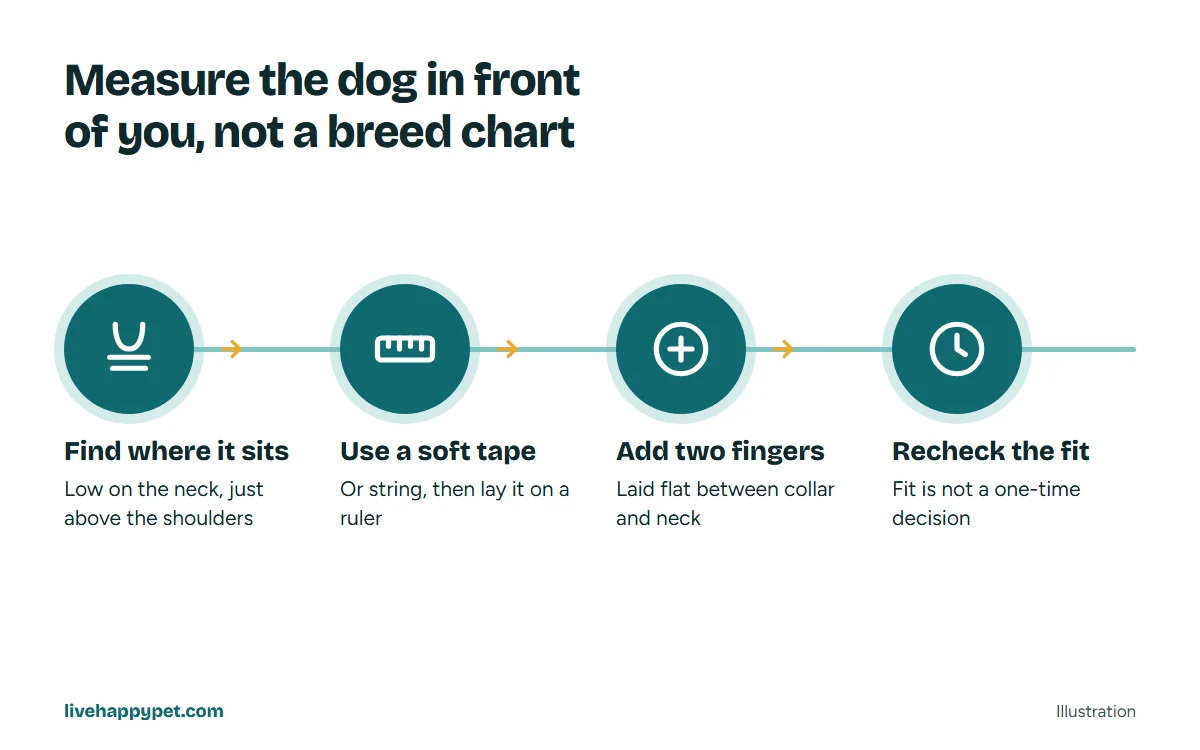
Illustration: Livehappypet
How Names and Phone Numbers Are Added to Dog Collar With Name?
Answer: There are four ways to put a name and a phone number on a collar: embroidered thread stitched straight into the webbing, a metal plate riveted to the strap, laser engraving on the buckle itself, and a tag hanging from the D-ring. They do not wear out at the same rate.
There are four ways to put a name and a phone number on a collar: embroidered thread stitched straight into the webbing, a metal plate riveted to the strap, laser engraving on the buckle itself, and a tag hanging from the D-ring. They do not wear out at the same rate.
Embroidery is the quietest and the hardest to lose, because the lettering is part of the strap. Nothing swings, nothing snags, and there is nothing to unclip. It fades, though. Sun bleaches the thread and mud grinds into it, so a contrast color such as white or black on a dark strap stays readable far longer than tonal thread, and digits embroidered at a generous size outlast a long name squeezed small. Expect to reorder a heavily used embroidered collar before you would replace a plate.
A riveted plate is the most durable option for a working or outdoors dog. It lies flat, makes no noise, cannot be pulled off by undergrowth, and deep engraving on stainless steel or solid brass stays legible for years. The trade is permanence: the plate belongs to that one strap, you cannot move it to the spare, and if your phone number changes you are buying a new collar. Dogs that swim should have the rivets checked by hand every few weeks, since that is the one place a plate quietly loosens.
Engraved buckles and hanging tags sit at the two extremes. An engraved buckle looks clean and carries nothing extra, but the lettering is small, it sits exactly where a dog's chin rubs, and it is attached to the component most likely to be replaced. A hanging tag is the opposite: easy to read from a distance, easy to swap between collars, and easy to lose, because the thin split ring in the packet works itself open with rotation. If you use one, replace that ring with a heavier split ring or a screw-closed ring.
What goes on the collar matters more than how it got there. Put a mobile number first and as large as the blank allows, because a stranger holding an excited dog needs to read it at arm's length. A second number is the single most useful addition, since the first phone is often the one left at home. Leave your street address off entirely. The pet's name is genuinely a judgement call: it helps a finder settle a frightened dog, and it also lets a stranger call your dog away from you, so a common compromise is the name on the back and contact details on the front.
If you are ordering a custom or personalized strap, treat it as made to order from the moment you click. Measure the dog that week rather than trusting last year's number, proofread the spelling and the digits twice, and expect that a personalized collar cannot be exchanged for a different size. Order it with enough lead time that it arrives before the trip, the move or the holiday you wanted it for, and keep a plain spare with a hanging tag so the dog is never without identification while the custom one is being made.
What Should Pet Owners Know About Walking a Dog That Pulls Without Relying on Dog Collar With Name?
Answer: A flat collar is fine for a dog that already walks on a loose lead. For a dog that throws its whole weight into the lead, all of that force lands on a narrow band across the windpipe. Nothing that tightens around the throat belongs on a puller, and that includes chain slip collars.
A flat collar is fine for a dog that already walks on a loose lead. For a dog that throws its whole weight into the lead, all of that force lands on a narrow band across the windpipe. Nothing that tightens around the throat belongs on a puller, and that includes chain slip collars.
Looking for more options? Our e collar roundup covers additional top picks.
A well-fitted front-clip or no-pull harness fixes the mechanics the same day. The lead attaches at the chest, so a lunge turns the dog gently sideways rather than loading the neck, and the force is spread across the shoulders and sternum. It is not training and it does not teach anything on its own, but it makes the walk safe enough that training can happen at all. A double-ended lead clipped to both the chest and the back ring gives you steering without any tightening anywhere.
Some dogs should be on a harness regardless of how they walk. Flat-faced breeds that already work hard to breathe, small dogs with delicate necks, dogs recovering from any neck or spinal problem, and dogs on long lines where a sudden stop is likely are all better served by spreading the load. If your dog coughs, gags or makes a honking noise on the lead, stop using a neck attachment and ask your veterinarian to look at it rather than buying different hardware.
Keep the collar on anyway. The harness is where the lead goes; the collar is where identification lives, and a harness can be backed out of by a frightened dog far more easily than people expect. The combination most experienced owners end up with is a plain, well-made collar carrying a tag and a plate, plus a harness for the walk itself.
How to Wash and Inspect Dog Collar With Name?
Answer: Nylon webbing holds whatever the dog rolled in and then holds it against the skin. Wash it by hand in warm water with a mild soap, rinse until the water runs clear, and let it dry fully before it goes back on. A damp collar on a thick coat keeps the skin underneath wet.
Nylon webbing holds whatever the dog rolled in and then holds it against the skin. Wash it by hand in warm water with a mild soap, rinse until the water runs clear, and let it dry fully before it goes back on. A damp collar on a thick coat keeps the skin underneath wet.
Other materials want other treatment. Coated webbing is the easy one: rinse it under a tap, wipe it with a cloth, and it is done, which is the whole reason owners of swimmers buy it. Leather should be wiped, dried away from direct heat and treated occasionally with a leather conditioner, never soaked and never put in a machine. If you do use a washing machine for nylon, take the tags off first, put the collar in a mesh laundry bag so the buckle does not batter the drum, and air dry rather than tumble dry, because heat distorts plastic hardware.
The inspection takes under a minute and matters more than the wash. Run a thumbnail along the webbing where it passes through the slider and the buckle slot, since that is where fibers part first. Pull firmly on the D-ring and look at the stitching holding it, not at the ring. Click the buckle, listen for a clean snap, and try to twist the two halves apart. Press on any riveted plate to feel for movement. On leather, flex the strap and look for cracking at the holes.
Retire a collar at the first sign of parting fibers, a cracked buckle arm, a stitch line that has gone fuzzy or a D-ring that has started to open. Hardware does not fail gradually in a way you get to notice; it holds until a particular bad moment and then it does not. A collar is one of the cheapest things on the dog, and it is the one carrying everything else.
What Should Pet Owners Know About Common Mistakes Owners Make with Dog Collar With Name?
Answer: The most common mistake is buying by neck size on a breed chart instead of measuring the dog in front of you. The second is clipping the lead to the small ring that holds the identification tag rather than to the welded D-ring. Both are easy to fix and both end walks badly.
The most common mistake is buying by neck size on a breed chart instead of measuring the dog in front of you. The second is clipping the lead to the small ring that holds the identification tag rather than to the welded D-ring. Both are easy to fix and both end walks badly.
The third is leaving collars on two dogs who wrestle. A jaw gets hooked through a loose strap during play, both dogs panic, and the twisting that follows is genuinely dangerous to both of them. If your dogs play roughly together, take the collars off for play or use a breakaway design that releases under pressure, and keep a tag on a harness or put the collars straight back on afterwards.
The fourth is forgetting that fit is not a one-time decision. Puppies outgrow collars in a couple of weeks, a groom can remove the coat that was taking up the slack, and a dog that has gained or lost weight has a different neck. Set a reminder if you need to, and check with two fingers rather than by eye.
The last one is sentimental. A frayed collar that was expensive, or that was on the dog in a favorite photograph, keeps getting put back on. Keep it in a drawer if it means something, and put a sound one on the dog. The strap is only doing its job on the day it is asked to hold.
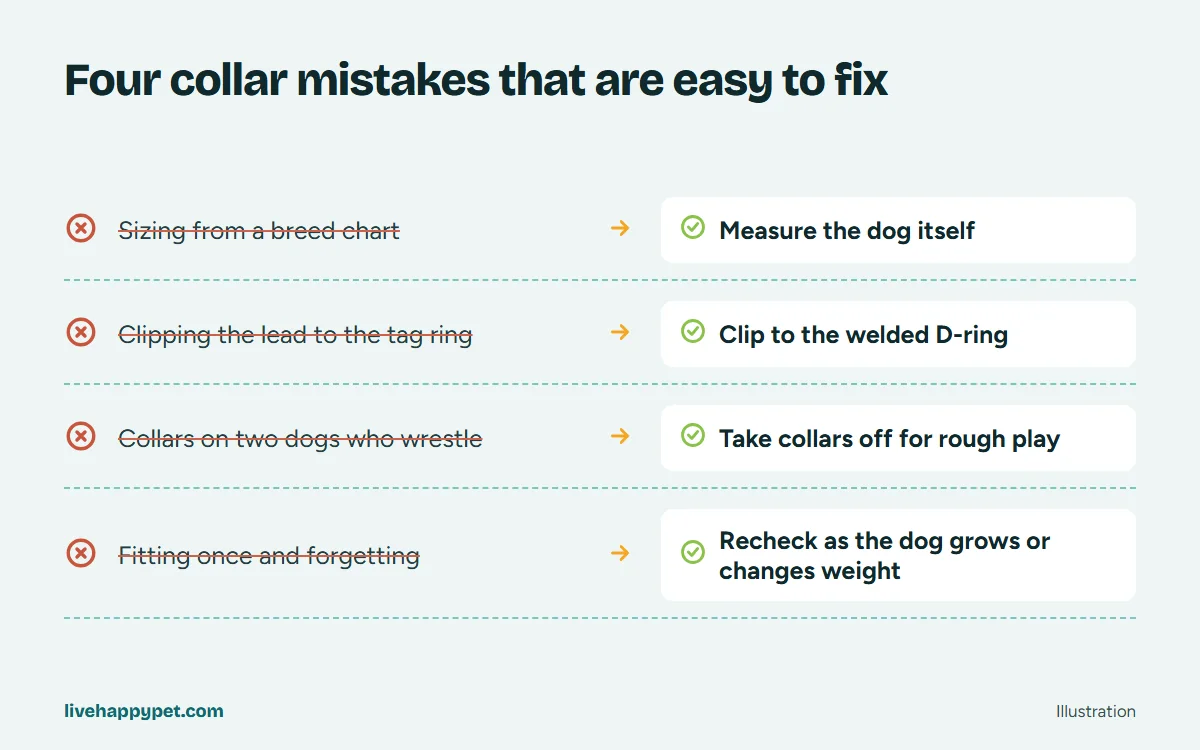
Illustration: Livehappypet
What Should Pet Owners Know About Getting the Best Value When Shopping for Dog Collar With Name?
Answer: Spend on the parts that take load and save on the parts that only look nice. Dense webbing, a metal buckle, a bar-tacked D-ring and sealed edges cost very little more than the decorative equivalent, and they are the difference between a collar that lasts years and one that lasts a season.
Spend on the parts that take load and save on the parts that only look nice. Dense webbing, a metal buckle, a bar-tacked D-ring and sealed edges cost very little more than the decorative equivalent, and they are the difference between a collar that lasts years and one that lasts a season.
Searches for a fashion label such as Coach are usually about how the collar looks, and that is a fair thing to want. Just understand the trade before you buy. A logo-canvas or fine calfskin strap is generally spot-clean only, its plated hardware is chosen to match a handbag rather than to hold a lunging dog, and it rarely has reflective stitching or a welded load-bearing ring. Livehappypet does not carry that label. If you want the look, treat it as a house and photograph collar and put a working strap on the dog for walks, rain and water.
Two cheaper habits save more money than any single purchase. Keep a plain spare, because a collar that goes missing on a Sunday otherwise means a dog with no identification for a week. And buy the collar and the lead together so you can check that the lead clip actually passes through the D-ring you intend to use, which is a mismatch people discover at the front door.
If the webbing on the current strap is already fuzzing at the slider, replace the whole thing rather than nursing it along with a new tag ring. Our dog collar and lead range is a sensible place to start, and it is worth measuring the dog again that same evening rather than reordering the size that is written on the old label.
Organizations like the VCA Animal Hospitals pet health library also offer trusted, science-backed advice that is well worth bookmarking.
What Questions Do Pet Owners Ask About Dog Collar With Name?
Answer: Choosing dog collar with name well comes down to four things: matching the product to your pet's size and daily routine, checking the materials against how hard it will be used, setting it up or fitting it correctly, and inspecting it on a schedule. This guide covers each of those, plus the mistakes owners most.
How tight should a dog collar be?
Snug enough that you can slide two fingers flat between the webbing and the neck, and no looser. Check it low on the neck where the collar actually sits, not up under the jaw. If you can get a whole hand underneath, a determined dog can back out of it; if two fingers are a struggle, let it out a notch.
What is the best material for a dog collar?
For most dogs, tightly woven nylon webbing with metal hardware. If your dog swims or lives in mud, coated webbing rinses clean under a tap and never holds a smell. Leather is lovely on a dog that stays mostly dry and ages beautifully, but it cracks if it is repeatedly soaked. Neoprene lining helps short-coated dogs that chafe.
Is a nylon dog collar strong enough for a large dog?
Yes, as long as the weave is dense and the hardware is metal. Nylon webbing itself is far stronger than any dog; what breaks is the plastic side-release buckle, the sliding adjuster, or the stitching holding the D-ring. For a big or lunging dog, choose a metal pin buckle and a welded ring held in a bar-tacked, folded tab.
What information should go on a personalized dog collar?
Your mobile number first, and as large as the space allows, because a stranger has to read it at arm's length. A second contact number is the most useful addition. Leave your street address off. Putting the dog's name on is a judgement call, so many owners keep the front for contact details and put the name on the back.
Does embroidery or a riveted plate last longer?
A riveted plate stays readable longer, especially on a dog that swims or pushes through undergrowth, because deep engraving on steel or brass does not fade. Embroidery never snags and never gets lost, but sun and grit dull the thread over a season. Both comfortably outlast a hanging tag on a thin split ring.
Can a puppy wear a collar, and how often should I check the fit?
Yes. Start with a light, soft collar worn for short indoor spells so the puppy gets used to it, and check the two-finger fit at least weekly while it is growing, because puppies outgrow a setting in a matter of days. Take the collar off for crate time and unsupervised play.
Should I walk my dog on a collar or a harness?
If your dog already walks on a loose lead, a flat collar is fine. If it pulls hard, is flat-faced, is very small, or coughs on the lead, use a well-fitted front-clip harness so the load goes across the chest instead of the windpipe. Keep the collar on for identification either way, and ask your veterinarian if the coughing continues.
How do I wash a dog collar without ruining it?
Hand wash nylon in warm water with a mild soap, rinse it until the water is clear and let it air dry completely before it goes back on. Take the tags off first. Coated webbing just needs a rinse and a wipe. Leather should be wiped and conditioned, never soaked or machine washed, and nothing should go in a tumble dryer.
Browse Collars and Leads
Free US shipping on every order. No minimum purchase required.
Browse Collars and Leads →