Top photo: a ginger and white cat asleep on striped bedding. Photo: Javier Perez Montes / Wikimedia Commons, CC BY-SA 4.0 (cropped, resized and converted to WebP).
If you are looking for the best cat warmer pad, this comprehensive guide covers everything you need to know. Whether you are a first-time pet owner or an experienced one looking to upgrade, you will find practical advice, safety tips, and honest comparisons below.
Quick Answer: What Should You Know About Cat Warmer Pad?
Self-warming pads use no power and are the safest default for most homes. Electric ones need a thermostat, a chew-resistant cord, a layer of fabric on top and a cat that can move away. Warmth is comfort rather than treatment, and a cat suddenly hunting for heat should see a veterinarian.
What a Cat Actually Gets From Cat Warmer Pad?
Answer: A warming pad gives a cat a reliable patch of low heat it can take or leave. Cats run warmer than people and seek out surfaces well above room temperature, which is why they colonise radiators, laptops and sunny floorboards. A pad simply makes that patch predictable and keeps it off the oven door.
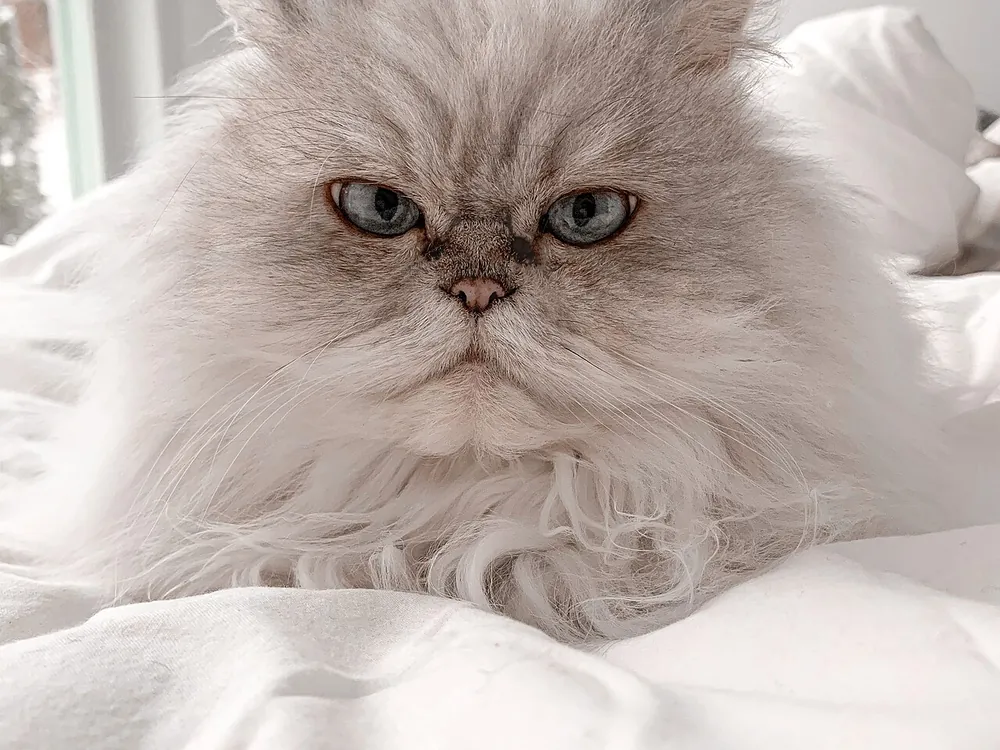
Photo: Laurieblou / Wikimedia Commons, CC BY-SA 4.0
A warming pad gives a cat a reliable patch of low heat it can take or leave. Cats run warmer than people and seek out surfaces well above room temperature, which is why they colonise radiators, laptops and sunny floorboards. A pad simply makes that patch predictable and keeps it off the oven door.
A pad is not a bed, and the difference is the practical point. A bed asks a cat to adopt a new place; a pad slides into a place the cat has already chosen, inside the carrier, along the windowsill, under the throw on the armchair, in the back of the wardrobe. That is why padded warmers get used when beds get ignored.
What gentle warmth does is ease stiffness and cut the effort of staying warm, which matters most to a cat that is old, thin or recovering. What it does not do is treat anything. Heat is comfort rather than therapy, and a cat that has suddenly started hunting for warmth, pressing against radiators or sleeping somewhere new should be seen by a veterinarian rather than handed a pad.
Outdoor and shelter cats are a separate case. A pad inside an insulated shelter keeps a feral or barn cat off frozen ground, and that job calls for an outdoor-rated unit with an armoured cord and nothing improvised. Indoors, most homes are warm enough that padding and position matter more than wattage, which is worth knowing before you spend.
What Should Pet Owners Know About Different Types of Cat Warmer Pad and When to Use Each?
Answer: There are three kinds and they are not interchangeable. Self-warming pads use no power at all and reflect the cat's own body heat back at it. Low-voltage electric pads plug in and hold a set temperature. Microwavable disc pads are heated in the kitchen and then cool slowly over several hours.
There are three kinds and they are not interchangeable. Self-warming pads use no power at all and reflect the cat's own body heat back at it. Low-voltage electric pads plug in and hold a set temperature. Microwavable disc pads are heated in the kitchen and then cool slowly over several hours.
Cat parents might also find our cat couch guide helpful.
The self-warming kind is the safest default and the least understood. Inside the padding sits a thin metallic film, usually mylar, that reflects body heat back toward whatever is lying on it, while the fleece above and the foam below slow that heat escaping. It cannot overheat, it cannot be chewed into a live wire, and it still works in a power cut. It also does nothing to an empty bed, so a cat has to settle for a few minutes before anything happens.
Electric pads are the strongest option and the one with rules attached. Good ones run low voltage through a transformer rather than mains voltage at the pad itself, hold a temperature a little under a cat's own body heat instead of climbing without limit, and carry a chew-resistant or steel-wrapped cord. The cheap ones that simply warm up until you unplug them are behind most of the horror stories.
Microwavable discs sit between the two. A gel or grain-filled pad takes a short burst in the microwave, then gives off fading warmth for a few hours inside a bed or a carrier, which makes it genuinely useful for travel, for a veterinary trip, or for a cat convalescing somewhere with no socket. The catch is that it is hottest at the start, so it must be wrapped and tested against your own wrist first.
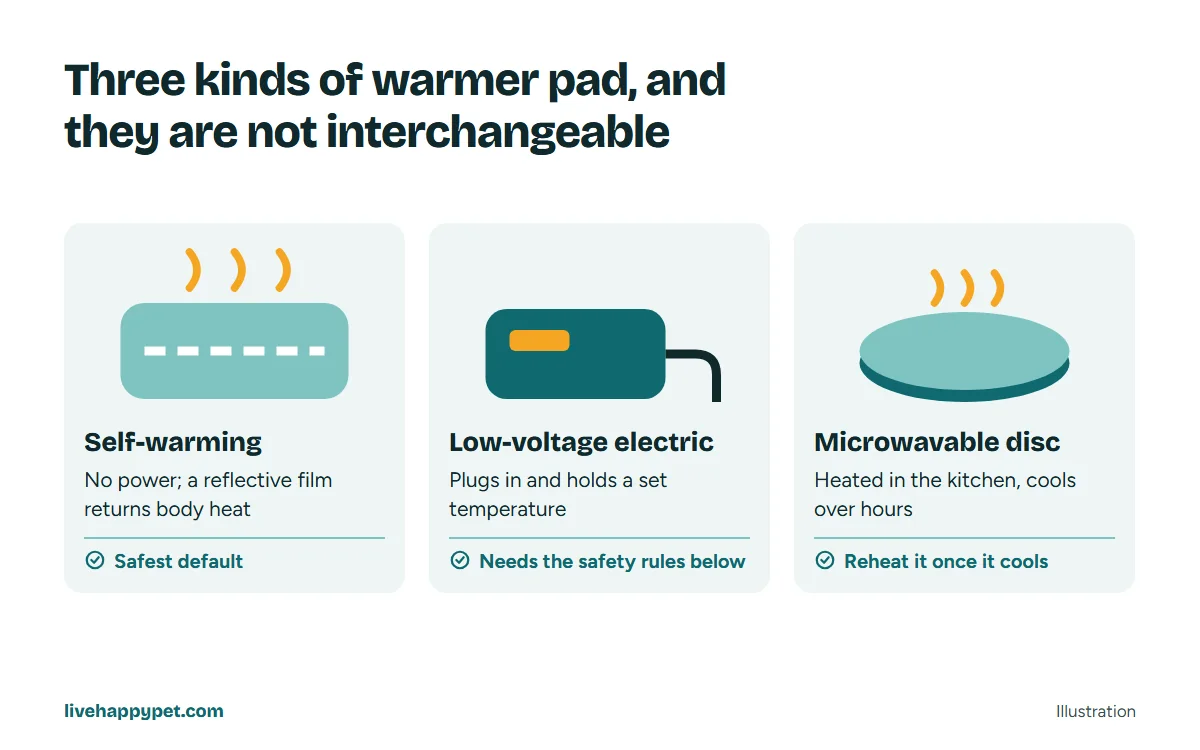
Illustration: Livehappypet
What Should Pet Owners Know About Safety Rules for Electric Cat Warmer Pad?
Answer: Electric pads earn their rules. Use one with a thermostat rather than constant heat, keep a layer of fabric between the pad and the cat, never fold it, never run it under a cat that cannot move away, and look at the cord every single time you switch it on.
Electric pads earn their rules. Use one with a thermostat rather than constant heat, keep a layer of fabric between the pad and the cat, never fold it, never run it under a cat that cannot move away, and look at the cord every single time you switch it on.
The cord is the part cats damage. Look for a steel-wrapped or heavily armoured lead, route it behind furniture rather than across open floor, and sleeve it in a cord protector if your cat chews. If you find teeth marks, retire the pad rather than taping it, because there is no safe home repair on a heating element. Keep it in a socket you can reach quickly.
Folding a pad presses the heating element against itself and creates a hot spot, which is how fabric scorches. Lay it flat, let the whole surface breathe, and never stack heavy bedding, a hot water bottle or a second heat source on top of it. One thin fleece or a pillowcase over the padding is right, a folded duvet is not.
Never put a pad under a cat that cannot get off it. That includes a cat recovering from anaesthetic, a heavily sedated cat, a cat confined to a crate with no cool corner, and a very young kitten. Cats regulate temperature by moving, so always leave half the resting area unheated. Human heating pads are a different product with a different thermostat and are not a stand-in.
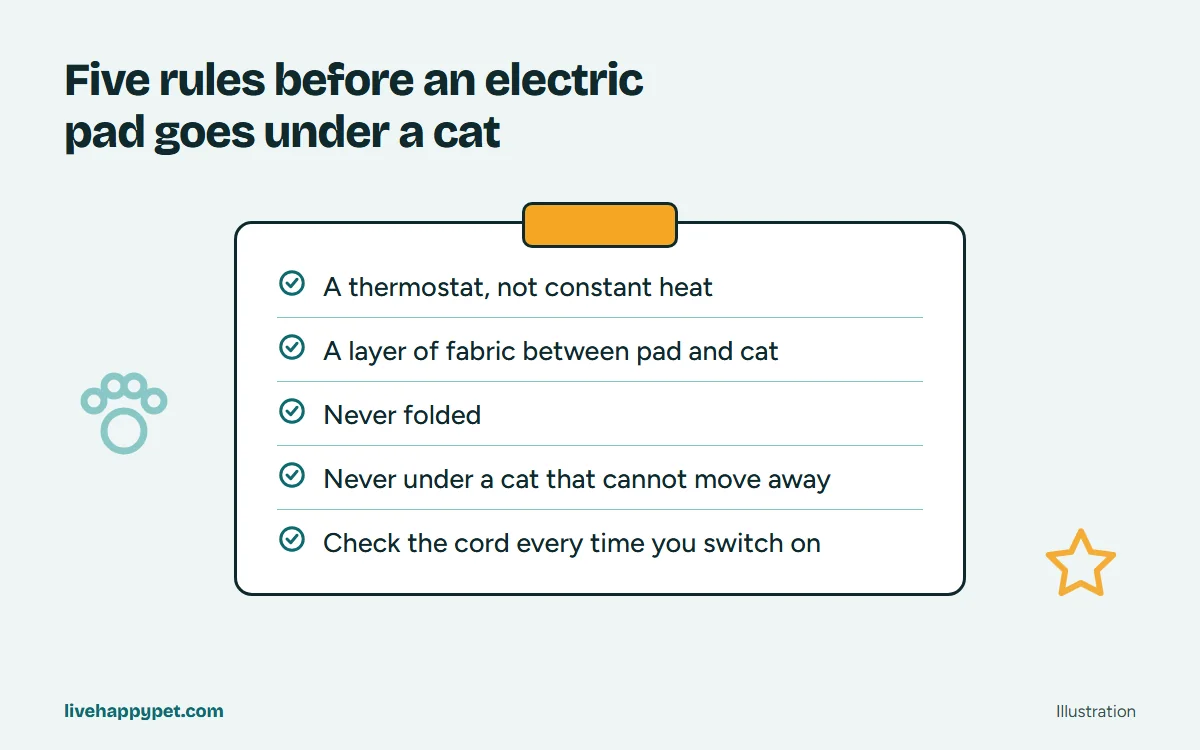
Illustration: Livehappypet
Which Cats Benefit From Cat Warmer Pad and Which Should Not?
Answer: Older cats, arthritic cats, thin or short-coated cats and cats recovering from illness get the most from steady low warmth, because holding body temperature costs them effort they would rather spend elsewhere. Healthy adults in a heated house usually need nothing and will use a pad only when it happens to suit them.
Older cats, arthritic cats, thin or short-coated cats and cats recovering from illness get the most from steady low warmth, because holding body temperature costs them effort they would rather spend elsewhere. Healthy adults in a heated house usually need nothing and will use a pad only when it happens to suit them.
For more feline-friendly picks, browse our cat bowls roundup.
Some cats should not be left on one unsupervised. Kittens cannot reliably move away and cannot tell you they are too warm. Any cat that cannot move freely, whether through injury, sedation or confinement, has no escape route. Cats with reduced sensation or poor circulation are at risk for the same reason, and your veterinarian is the person to ask whether that describes yours.
Placement decides whether the thing gets used at all. Put the padding where the cat already sleeps rather than where the socket happens to be, keep it out of draughts and off cold tiles, and make sure half the resting surface stays unheated. A pad slipped under one half of the blanket in an existing bed gets adopted far more often than a new heated bed in a new spot.
If the cat avoids it, that is information rather than a fault. Usually the position is wrong, the surface feels strange underfoot, or the house is simply warm enough that a heated patch holds no interest. Occasionally it is running hotter than the cat wants, which the back of your hand will tell you. Leave it unheated in the right place for a week before concluding anything.
What Should Pet Owners Know About Low-Temperature Burns and What to Watch for Around Cat Warmer Pad?
Answer: The risk with a warming pad is not a sudden burn, it is a slow one. Skin can be damaged by moderate heat held against it for a long stretch, which is exactly what happens when a cat sleeps all night in one position, and a coat of fur hides the early signs from a.
The risk with a warming pad is not a sudden burn, it is a slow one. Skin can be damaged by moderate heat held against it for a long stretch, which is exactly what happens when a cat sleeps all night in one position, and a coat of fur hides the early signs from a casual glance.
It happens to the cats least able to react. A cat that cannot move away, cannot feel the heat properly, or is simply too deeply asleep to shift does not do the thing that normally protects it, which is to get up and go elsewhere. Every rule about thermostats, fabric layers and leaving part of the bed cool exists for that reason.
Check the cat, not the pad. Part the fur over the belly, the hips, the elbows and anywhere that rests flat, and look for redness, a patch warmer than the skin around it, thinning or singed-looking fur, a dry crusty area, or a spot the cat has started licking at. Anything resembling a burn, however mild, needs a veterinarian rather than a home remedy, because this kind of damage usually runs deeper than it looks.
Build a small habit around it. Feel the padding with the back of your hand once a day while the cat is off it, switch it off when the room is warm or the house is empty, and glance at where the cat has been lying after a long sleep. None of that takes a minute, and it is very nearly the whole of the maintenance.
What Should Pet Owners Know About Washing and Replacing Cat Warmer Pad?
Answer: Most pads have a removable cover and a core that has to stay dry. Wash the cover on a gentle cycle, wipe the core with a damp cloth only, never submerge an electric pad or a microwavable disc, and let everything dry completely before anything is plugged in or slept on again.
Most pads have a removable cover and a core that has to stay dry. Wash the cover on a gentle cycle, wipe the core with a damp cloth only, never submerge an electric pad or a microwavable disc, and let everything dry completely before anything is plugged in or slept on again.
If your cat needs variety, our heated cat guide has great suggestions.
Self-warming pads are the easiest, since there is no electronics to protect, but the reflective film inside does not survive a hot wash or a tumble dryer. Use a cool gentle cycle, reshape the padding while it is damp, and dry it flat. A reflective layer that has creased or torn stops working, which is the usual reason an older self-warming pad feels like an ordinary mat.
Replace a pad sooner than you would replace a bed. Retire an electric one at the first sign of a cracked or chewed cord, a scorch mark, a smell of hot plastic, a lump where the element has shifted, or warmth that has gone uneven to the hand. Retire a microwavable disc once the gel has gone grainy or a seam has started to weep. Retire a self-warming one when the padding has flattened enough that the cat is effectively lying on the floor.
Store them properly out of season. Roll an electric pad rather than folding it, coil the cord loosely instead of winding it tight around the body, and keep the whole thing dry and out of reach of a bored cat. Look it over before it goes back into service in the autumn rather than on the first cold night.
What Should Pet Owners Know About Common Mistakes Pet Owners Make with Cat Warmer Pad?
Answer: The commonest mistake is leaving an electric pad running around the clock. One that is on constantly in a warm room gives the cat nowhere cooler to go, wastes electricity and ages the element faster than anything else will. Switch it on when the house is genuinely cold and off when it is not.
The commonest mistake is leaving an electric pad running around the clock. One that is on constantly in a warm room gives the cat nowhere cooler to go, wastes electricity and ages the element faster than anything else will. Switch it on when the house is genuinely cold and off when it is not.
The second is improvising. A human heating pad, a loose hot water bottle, a reptile mat or a sock of heated rice all deliver warmth without the controls a cat needs, and none of them are built to sit under an animal that cannot say when it has had enough. If you want a warm spot in a hurry, a wrapped hot water bottle under a folded towel, in a bed the cat can leave freely, is the safer improvisation.
The third is burying it. Owners tuck the padding under a thick duvet, fold it to fit a smaller bed, or stack another blanket on top so the warmth is held in, and all three create hot spots and trap heat the cat cannot escape. One thin layer above, nothing heavy, and the pad flat.
The fourth is treating warmth as a diagnosis. A pad can make a stiff old cat more comfortable, and it will not slow arthritis, clear an infection, or explain why a cat has started sleeping somewhere new. A cat that suddenly seeks heat, hides, or changes where it rests is telling you something, and the right response is a veterinary appointment rather than a warmer bed.
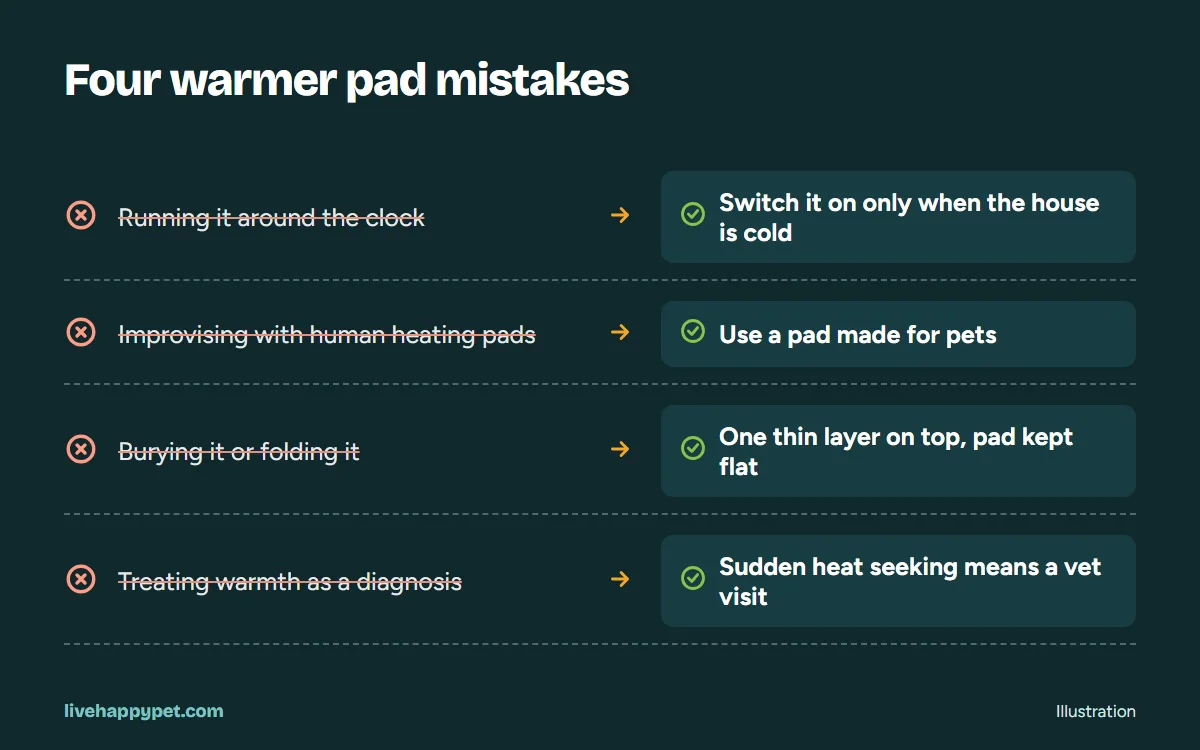
Illustration: Livehappypet
What Should Pet Owners Know About Getting the Best Value When Shopping for Cat Warmer Pad?
Answer: Start with the cheapest option, because it is also the safest. A self-warming pad costs a fraction of an electric one, needs no socket and suits most indoor cats in a heated house. Buy the electric version only when a particular cat genuinely needs more than its own body heat handed back.
Start with the cheapest option, because it is also the safest. A self-warming pad costs a fraction of an electric one, needs no socket and suits most indoor cats in a heated house. Buy the electric version only when a particular cat genuinely needs more than its own body heat handed back.
If you do go electric, pay for the controls and the cord and ignore everything else. A thermostat that holds a steady temperature, a low-voltage transformer, an armoured lead and a removable washable cover are the features worth money. Faux-fur trim, printed patterns and a built-in bolster are not, and a bolster only makes the padding harder to wash.
Buy for the curled cat rather than the stretched one, since a pad larger than the sleeping area wastes heat and leaves warm surface uncovered. Two small pads in two rooms beat one big pad in the wrong room. Avoid unbranded electric units with no safety marking of any kind, because the thermostat is essentially the whole product and it is the part being left out.
A warm spot is only half the job. Padding slipped into a bed the cat already loves beats a new heated bed in a new place every time, so if you are putting a resting corner together, our cat supplies range covers the beds, mats and wand toys that make the spot worth coming back to.
Organizations like the International Cat Care advice hub also offer trusted, science-backed advice that is well worth bookmarking.
What Questions Do Pet Owners Ask About Cat Warmer Pad?
Answer: Self-warming pads use no power and are the safest default for most homes. Electric ones need a thermostat, a chew-resistant cord, a layer of fabric on top and a cat that can move away. Warmth is comfort rather than treatment, and a cat suddenly hunting for heat should see a veterinarian.
Does my cat actually need a heated pad?
Most healthy adult cats in a heated home do not. The ones that genuinely benefit are old or arthritic cats, thin and short-coated cats, and cats recovering from illness, because keeping warm costs them effort. For everyone else it is a comfort rather than a need, and a sunny windowsill with a self-warming mat on it usually covers the whole requirement.
What is the difference between a self-warming pad and an electric one?
A self-warming pad has no power at all. A reflective film inside bounces the cat's own body heat back while the padding slows it escaping, so it warms only when a cat is lying on it and cannot overheat. An electric pad adds heat from a wall socket, gets much warmer, and brings a cord, a thermostat and a set of safety rules with it.
Is a human heating pad or a hot water bottle a safe substitute?
Not really. A human pad is built for a person who can move away and complain, so the thermostat and the cord are designed for a different user, and a reptile mat is worse again. A hot water bottle is the least bad improvisation if it is wrapped in a towel and placed in a bed the cat can leave freely, but it cools unevenly.
Should a heated pad be left switched on overnight?
Only if it has a proper thermostat, lies flat with a layer of fabric on top, and leaves the cat an unheated half of the bed to move to. Even then, many owners run it in the evening and switch it off at night. Never leave one running under a cat that cannot get up and walk away from it.
Which cats should not be left on a heated pad?
Kittens, any cat that cannot move freely because of injury, sedation or confinement, and cats with reduced sensation or poor circulation. The common factor is that a cat protects itself from too much heat by getting up, so a cat that cannot do that loses the safety mechanism. If you are unsure whether yours qualifies, ask your veterinarian first.
Can low heat really burn a cat?
Yes. Moderate warmth held against skin for hours can damage it even though it never feels dangerous to a hand, and fur hides the early stage. Part the coat over the belly, hips and elbows now and then and look for redness, thinning or singed fur, a crusty patch, or a spot the cat keeps licking. Anything like that needs a veterinarian.
Are microwavable heat pads worth buying?
For travel, carriers and cats recovering somewhere without a socket, yes. A gel or grain disc takes a short burst in the microwave and then releases fading warmth for a few hours with no cord to chew. The drawback is that it is hottest the moment it comes out, so it must be wrapped and tested on your own wrist before it goes near a cat.
My cat will not use the pad. What should I change?
The position, before anything else. Move it to the place the cat already sleeps, out of draughts and off cold tile, and leave half the resting area unheated. Put a familiar blanket over it so the surface feels normal underfoot. Leave it switched off for the first few days, then warm it once the cat is using the spot anyway.
Browse Cat Supplies
Free US shipping on every order. No minimum purchase required.
Browse Cat Supplies →