Top photo: a grey tabby cat resting on a stone ledge with a round tag on its collar. Photo: Jules Verne Times Two / Wikimedia Commons, CC BY-SA 4.0 (cropped, resized and converted to WebP).
If you are looking for the best cat tracker collar, this comprehensive guide covers everything you need to know. Whether you are a first-time pet owner or an experienced one looking to upgrade, you will find practical advice, safety tips, and honest comparisons below.
Quick Answer: What Should You Know About Cat Tracker Collar?
Choosing cat tracker collar well comes down to four things: matching the product to your pet's size and daily routine, checking the materials against how hard it will be used, setting it up or fitting it correctly, and inspecting it on a schedule. This guide covers each of those, plus the mistakes owners most often make.
Why Outdoor Cat Owners Keep Looking at Cat Tracker Collar?
Answer: Most cats that go missing are hiding close to home, silent and wedged somewhere no human would think to look. The hard part is almost never distance, it is knowing which garden to search first. A tracker on the collar turns a blind sweep of the whole street into a short walk toward a dot.

Photo: Annie X / Wikimedia Commons, CC BY 3.0
Most cats that go missing are hiding close to home, silent and wedged somewhere no human would think to look. The hard part is almost never distance, it is knowing which garden to search first. A tracker on the collar turns a blind sweep of the whole street into a short walk toward a dot.
Speed is the whole argument. A frightened cat goes to ground and will not answer a familiar voice, so calling into the dark can fail for days while the cat sits a few yards away behind a shed. A tracking device gives you a direction instead of a hope, and it lets you search the right fence line in daylight rather than the wrong one at midnight.
Be clear about what the device actually reports, though. It reports where the collar is, and the collar is the cat only for as long as it is still on the cat. It reports nothing at all once the battery is flat or the data plan has lapsed, which is why the habits around a tracker matter far more than the specification on the box.
An indoor cat earns one too, for a different reason. The cats that vanish through a propped door or a torn screen are the ones nobody was watching, and they hide harder than an outdoor cat because everything outside is unfamiliar territory. If your cat bolts at the vacuum cleaner, a tracker is insurance rather than a gadget.
What Should Pet Owners Know About Different Types of Cat Tracker Collar and When to Use Each?
Answer: There are three categories worth knowing. A satellite tracker works out its own position and sends it to your phone over a mobile network. A Bluetooth or crowd finding tag has no position and waits for a stranger's phone to notice it. A radio tracker sends a signal you follow with a handheld receiver.
There are three categories worth knowing. A satellite tracker works out its own position and sends it to your phone over a mobile network. A Bluetooth or crowd finding tag has no position and waits for a stranger's phone to notice it. A radio tracker sends a signal you follow with a handheld receiver.
Cat parents might also find our cat couch guide helpful.
The satellite type is what most people mean by a pet tracker. The device reads the GPS satellite signals overhead, works out where it is, then uses a mobile data connection to push that position into an app, which is why it carries a subscription and why it needs charging on a schedule. It is also the heaviest of the three, because it has to carry both a radio and a battery big enough to run one.
A crowd finding tag is a different animal entirely. It is a small Bluetooth beacon with a coin cell, no subscription and no GPS receiver inside it at all, which is the detail most buyers miss. It appears on a map only when somebody else's phone, running the right network, passes close enough to hear it and quietly reports the sighting. In a busy apartment block that happens constantly. In a hedgerow at the edge of town it may never happen at all, and a tag that has not been heard since yesterday tells you about yesterday.
Radio direction finding is the oldest approach and the one rural cat owners keep returning to. A light transmitter on the collar sends a beep, and a handheld receiver tells you how strong that signal is and roughly which way it came from, so you sweep until it gets louder. There is no subscription, no GPS, no mobile coverage needed and no map, which means it still works in a valley with no signal, and it also means you have to be outside walking with the receiver in your hand.
What the Subscription and the Charging Routine Mean for Cat Tracker Collar?
Answer: A cellular tracker is a service as much as an object. The device goes quiet the day the card on the account is declined or the battery runs flat, and the night your cat does not come home is exactly the night you find out which of those two things happened.
A cellular tracker is a service as much as an object. The device goes quiet the day the card on the account is declined or the battery runs flat, and the night your cat does not come home is exactly the night you find out which of those two things happened.
Treat the subscription as part of the product rather than a surprise. Plans are usually billed monthly or for a year at a time, and a yearly plan on an expired card fails silently, because nothing on the collar tells you it has stopped reporting. Put the renewal on a card you do not replace often, keep the account on an email address you still read, and open the app now and then purely to confirm it is showing a recent position.
Charging is where good intentions go to die. Hook it to something you already do, the evening the bins go out or the morning you refill the water fountain, and keep the cable in the room where the cat food lives rather than in a drawer. A spare collar helps a great deal: swap collars while the device charges, so your cat is never outdoors wearing nothing at all.
Battery life and update frequency are the same dial turned two ways. A device that checks in often drains quickly, and the same device checking in rarely lasts far longer while showing you a staler position at the moment you need a fresh one. Most apps let you choose, and the sensible setting is relaxed for ordinary days with a live mode you switch on during a search, which is also the mode that empties the battery fastest.
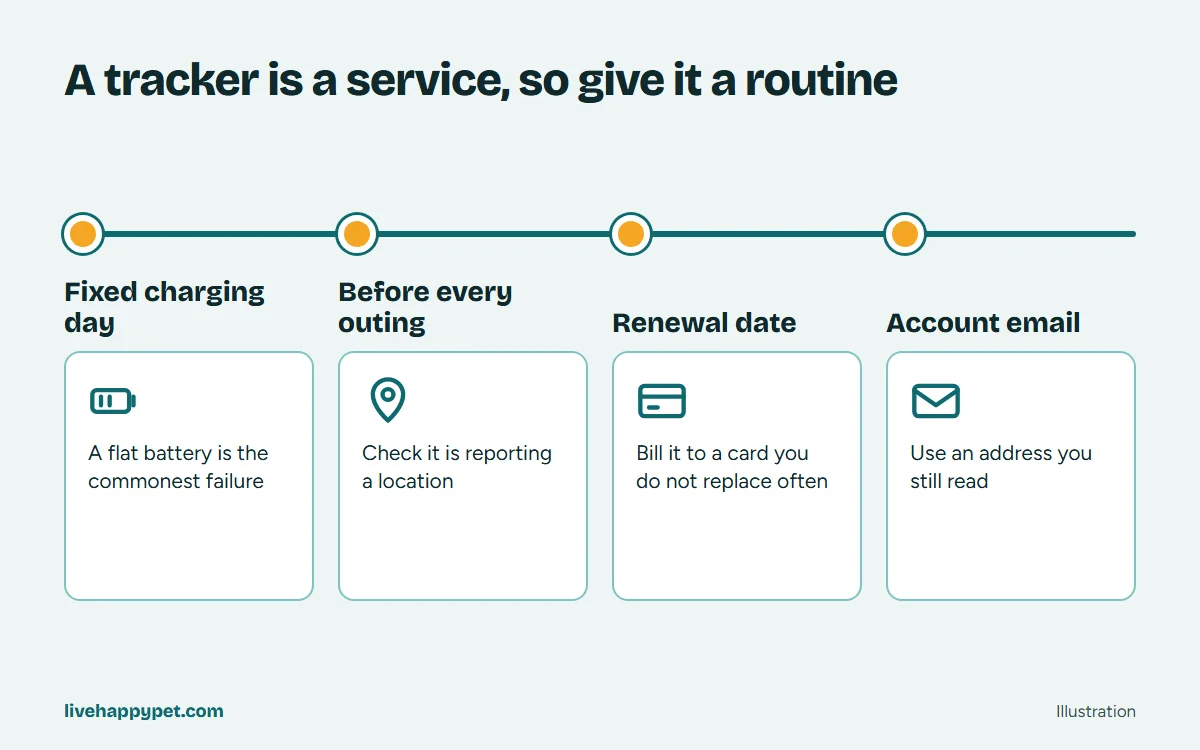
Illustration: Livehappypet
What Should Pet Owners Know About Weight, Breakaway Collars and Attaching Cat Tracker Collar Safely?
Answer: Weight is the constraint that decides everything else on a cat. A cat collar has to be a breakaway design, and a device heavy enough to drag on that buckle will pop it open on the first fence post, leaving you with no collar, no tag and no tracker to follow.
Weight is the constraint that decides everything else on a cat. A cat collar has to be a breakaway design, and a device heavy enough to drag on that buckle will pop it open on the first fence post, leaving you with no collar, no tag and no tracker to follow.
For more feline-friendly picks, browse our cat bowls roundup.
Do not solve that by removing the breakaway. A collar that cannot release is a genuine strangulation risk for an animal that climbs, squeezes through gaps and hunts in hedges, and a harness left on an unsupervised cat is worse again. If the only way to keep a particular device on your cat is a fixed strap, the device is the wrong one, not the collar.
Weight and battery life pull against each other, so choose honestly between them. A lighter unit carries a smaller battery and needs charging more often, while a long running unit is bulkier and sits heavier under the chin. The right answer is the lightest device whose charging interval you will genuinely keep up with, because a heavy tracker left on a shelf has never found anything.
Mount it flat against the webbing rather than swinging from a ring, sit it at the side of the neck or under the chin where your cat will tolerate it, and leave room for two fingers under the collar. Then test the buckle again with the device attached, since the extra weight changes how the release behaves. Check the skin underneath every week for rubbing or thinning fur, and ask your veterinarian if you find any soreness.
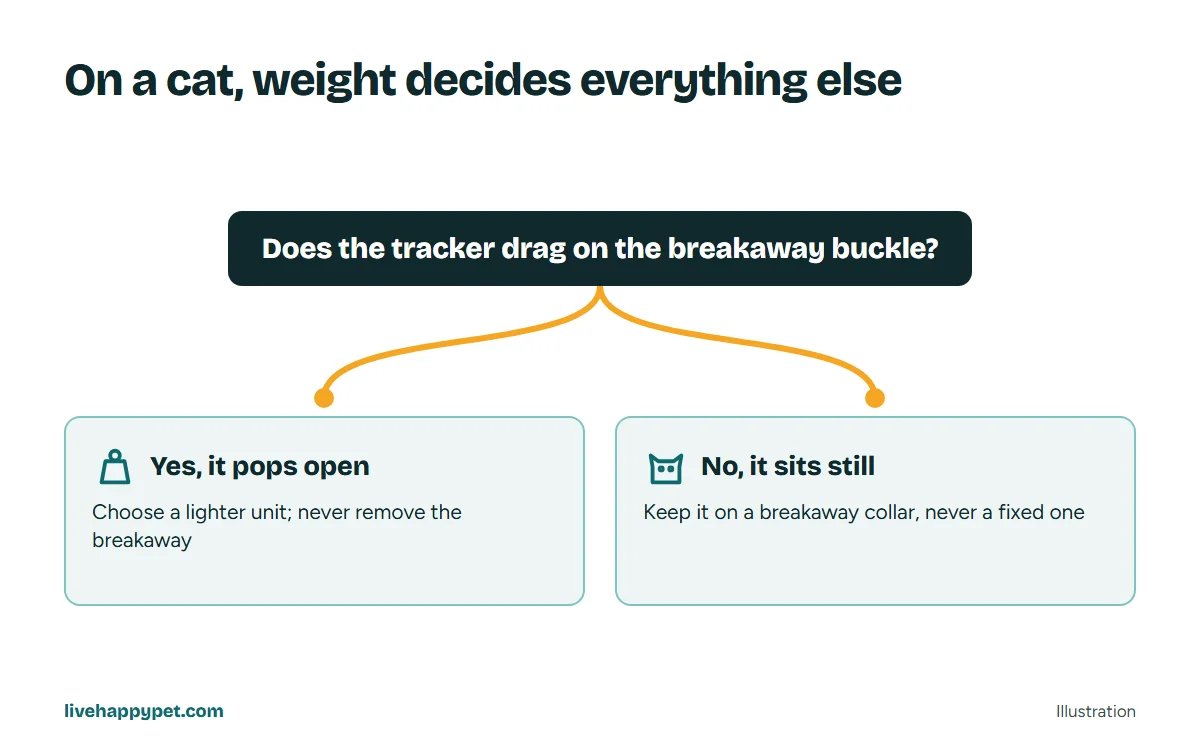
Illustration: Livehappypet
What Should Pet Owners Know About Coverage Gaps, Accuracy and Geofence Alerts from Cat Tracker Collar?
Answer: A satellite tracker needs a view of the sky to fix its position and a mobile signal to send it, and a cat under a shed, in a basement or inside a storm drain has neither. The last position you see is where the signal stopped, which is a starting point rather than an answer.
A satellite tracker needs a view of the sky to fix its position and a mobile signal to send it, and a cat under a shed, in a basement or inside a storm drain has neither. The last position you see is where the signal stopped, which is a starting point rather than an answer.
The motionless cat is the hard case. Many devices report less often when nothing is moving, to save battery, so a cat wedged under decking for hours may be represented by an old dot that has drifted by a garden or two. In dense buildings the error gets worse, because GPS signals bounce off walls and arrive confused, and a position inside an apartment block will not tell you which floor or which flat.
Rural notspots are the other gap, and they are the reason radio tracking still sells. No mobile coverage means the device can know exactly where it is and have no way to tell you, and the same applies underground, in car parks and inside thick stone walls. If your own phone struggles where you live, check which network the tracker uses before you buy rather than after.
Geofence alerts draw a boundary on the map and notify you when the collar crosses it. The feature is genuinely useful and it is also the first thing most owners switch off, because ordinary position error makes a tight boundary around a small yard fire alarms all night while the cat sleeps on the sofa. Draw it generously, around the block rather than the flower bed, and read the alerts as a picture of your cat's routine rather than as a burglar alarm.
Why a Microchip and a Readable ID Tag Still Matter Alongside Cat Tracker Collar?
Answer: A tracker is a powered device on a collar that is designed to fall off, so it cannot be your only identification. The microchip is permanent and survives everything the collar does not, and an engraved tag is what lets the neighbor holding your cat simply phone you.
A tracker is a powered device on a collar that is designed to fall off, so it cannot be your only identification. The microchip is permanent and survives everything the collar does not, and an engraved tag is what lets the neighbor holding your cat simply phone you.
If your cat needs variety, our heated cat guide has great suggestions.
A chip only works if the registry entry behind it does. The number is useless when it points at a phone you stopped using two moves ago, so log in and check those details on the same afternoon you set up a new tracker account. Ask your veterinarian to scan the chip at the annual visit, which takes seconds and confirms it has not migrated or failed.
The tag is the fastest route home of the three. A stranger who finds a friendly cat owns no scanner and has not installed your tracking app, but anybody can read a number at arm's length and call it. Keep the tag light so it does not fight the breakaway buckle, and hang it on the same collar as the device. Our cat collars and accessories are a sensible place to start if the current collar is already frayed.
What Should Pet Owners Know About Common Mistakes Cat Owners Make with Cat Tracker Collar?
Answer: Three failures account for most of the disappointment: a flat battery, a lapsed plan and a device nobody ever tested. All three stay invisible until the evening the cat does not come in, and all three are fixed by a dull routine rather than by buying a better gadget.
Three failures account for most of the disappointment: a flat battery, a lapsed plan and a device nobody ever tested. All three stay invisible until the evening the cat does not come in, and all three are fixed by a dull routine rather than by buying a better gadget.
The next group of mistakes is about weight and comfort. Owners buy the unit with the longest battery life, the cat scratches at its neck, the collar comes off in a hedge on the first day, and the tracker spends the rest of its life in a drawer. Buy for the cat you actually have, and if your cat will not wear anything at all, admit that early and put the effort into the chip and the tag instead.
The third is trusting the map too literally. A stale dot in a neighbor's garden is a reason to knock politely and listen at the fence, not to climb it after dark. Share the account with everyone in the household as well, because the search always begins while the one person who installed the app is at work with their phone on silent.
The last one is quieter. A tracker is not permission to let an indoor cat outside, and it is no substitute for closing the window before the cleaner arrives. It tells you where your cat went. It does not keep your cat out of the road.
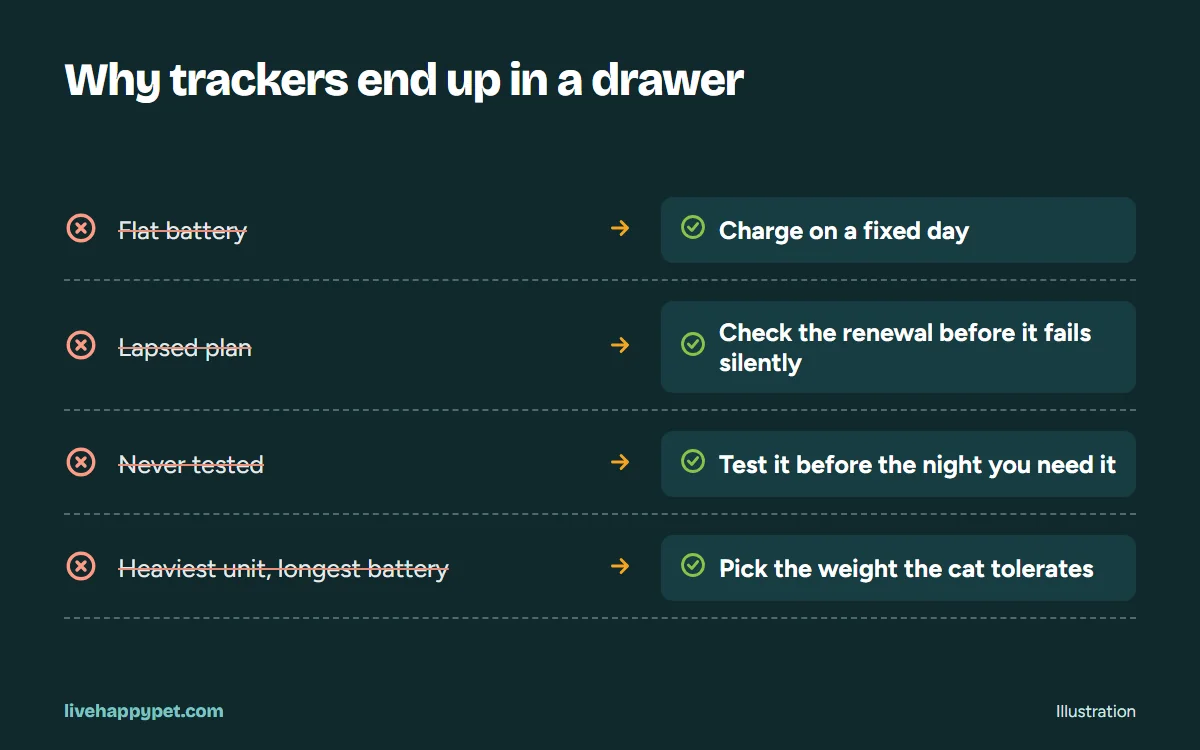
Illustration: Livehappypet
What Should Pet Owners Know About Getting the Best Value When Shopping for Cat Tracker Collar?
Answer: The cheapest tracker is the one you will still be paying for and still be charging next spring. A low price on the device with an expensive plan behind it costs more across a year than the reverse, so add the subscription to the sticker price before you compare anything.
The cheapest tracker is the one you will still be paying for and still be charging next spring. A low price on the device with an expensive plan behind it costs more across a year than the reverse, so add the subscription to the sticker price before you compare anything.
Spend on the things that decide whether it works at all: the network coverage where you actually live, the weight on your cat's neck, and a plan you are free to leave. A monthly plan costs more each month and is worth it for the first stretch, because it lets you walk away if the coverage in your valley turns out to be a promise on a map rather than a signal in the air.
Save on everything else. Step counts, sleep charts and wellness scores are pleasant, and no GPS tag has ever found a cat with them. A spare breakaway collar and a second charging cable are better money, and they are the parts you will lose first. Our pet supplies range covers the collar, the tag and the everyday kit that sits around the device.
What Should Pet Owners Know About Setting Up Cat Tracker Collar Before the Night You Need It?
Answer: Set it up on a quiet afternoon rather than in an emergency. Fit the collar, start the plan, charge the device fully, then hide it in the garden or the back of a cupboard and find it using nothing but the app. That rehearsal teaches you more than any manual does.
Set it up on a quiet afternoon rather than in an emergency. Fit the collar, start the plan, charge the device fully, then hide it in the garden or the back of a cupboard and find it using nothing but the app. That rehearsal teaches you more than any manual does.
Learn the app while you are calm. Find the live or refresh mode, the history view, the alert settings and whatever sound or light the device can produce, and practice switching live mode on and off. Add every adult in the house to the account, and work out in advance how you would give a neighbor enough access to help without handing over your password.
Then keep the paperwork current, which is the part everyone skips. The chip registry, the tracker account and the card paying for the plan all need the same phone number as the one engraved on the tag, and all three go stale after a move. Tie the check to something seasonal, look at the collar, the buckle and the engraving while you are there, and the whole system stays ready for a night you hope never comes.
For more independent, vet-reviewed guidance on this topic, the Cornell Feline Health Center is an excellent place to start.
What Questions Do Pet Owners Ask About Cat Tracker Collar?
Answer: Choosing cat tracker collar well comes down to four things: matching the product to your pet's size and daily routine, checking the materials against how hard it will be used, setting it up or fitting it correctly, and inspecting it on a schedule. This guide covers each of those, plus the mistakes owners most often.
Do cat GPS trackers work without a subscription?
The satellite kind does not. It sends its position over a mobile network, and that connection is what the monthly or yearly plan pays for, so a lapsed plan quietly turns the device into an ornament. Bluetooth crowd finding tags and radio direction finding units need no subscription at all, but neither of them gives you a live position on a map.
How heavy can a tracker be for a cat?
Light enough that the breakaway collar still releases with the device fitted, which is the only test that matters. Fasten everything, then pull firmly on the collar: if the buckle no longer pops open, that device is too heavy for that collar. Your cat will tell you too, by scratching at its neck or losing the collar daily. Ask your veterinarian before adding weight to a kitten or a frail older cat.
Will a Bluetooth tag find a lost cat?
Only indirectly, and only where people are. A crowd finding tag holds no position of its own; it waits for another phone running the same network to pass within range and report where it was heard. In a dense neighborhood that can work well. In woodland, farmland or an empty industrial estate, nobody walks past, so the map keeps showing the last place somebody did.
Why does my cat's tracker show the wrong location?
Because it is reporting the last position it managed to calculate and send, not where your cat is now. Walls, dense buildings and heavy cover scatter the signal, and most devices slow their updates right down when nothing is moving, to save battery. Treat the dot as the center of a circle to search on foot, and switch to live mode once you are close.
Is it safe for a cat to wear a tracker collar?
Yes, on a breakaway collar that still releases with the device attached, checked by hand rather than assumed. Keep the weight low, sit the unit flat against the webbing, leave two fingers of room, and look under the collar weekly for rubbing or thinning fur. Never switch to a fixed collar to stop losing a tracker, and never leave a harness on an unsupervised cat.
Does a GPS tracker replace a microchip?
No, and the two solve different halves of the problem. A tracker tells you where the collar is while it has charge and signal; a microchip is permanent, needs no battery and is what a vet or shelter reads when somebody hands your cat in. Keep the chip registry details current, keep a readable tag on the collar, and treat the tracker as the fast layer on top.
How often does a cat tracker need charging?
That depends on how often you have told it to report, how strong the signal is where your cat roams, and how cold the nights are, so no single answer fits. What matters more is building a fixed habit around it, attached to something you already do each week, and keeping a spare collar so your cat is never outside without identification while the device charges.
What should I do first if my cat is missing and the tracker is offline?
Go to the last reported position and search it slowly and quietly at dusk with a flashlight, checking sheds, crawl spaces, hedges and under parked cars within a few gardens of home. Then call the microchip registry, local vets and shelters, and post where neighbors will see it. The dot narrows the circle; the finding is still done on foot.
Shop Pet Supplies
Free US shipping on every order. No minimum purchase required.
Shop Pet Supplies →