A cat pet feeder automatic can release measured meals on a schedule, but it should support your care rather than stand in for it. The right machine can make breakfast predictable, split a daily allowance into several servings, and reduce guesswork when work runs late. It cannot decide how many calories your cat needs, recognize illness, or guarantee that food reached the bowl.
This guide focuses on the decisions that matter after the product page: selecting the right mechanism, checking real portion output, handling wet and dry food safely, and planning for power loss or a determined cat. For a shorter category overview, start with our comparison of automatic pet feeders for cats.
What an automatic feeder can and cannot do
Automatic feeders are useful when consistency is the problem. A healthy adult cat can receive an early breakfast without waking the household, or a daily allowance can be divided into smaller scheduled meals. The VCA guide to feline feeding frequency notes that suitable frequency depends on age and health. Automation follows a plan. It does not create one.
A feeder is less useful when appetite itself needs monitoring. Skipping food, vomiting, weight loss, changes in thirst, or altered litter box habits call for attention, not another app alert. Someone should inspect the cat, food, water, and litter every day. If you are upgrading the rest of the care station, compare our guides to cat water fountains and automatic litter boxes, while keeping food and water appliances far enough apart to avoid splashes.
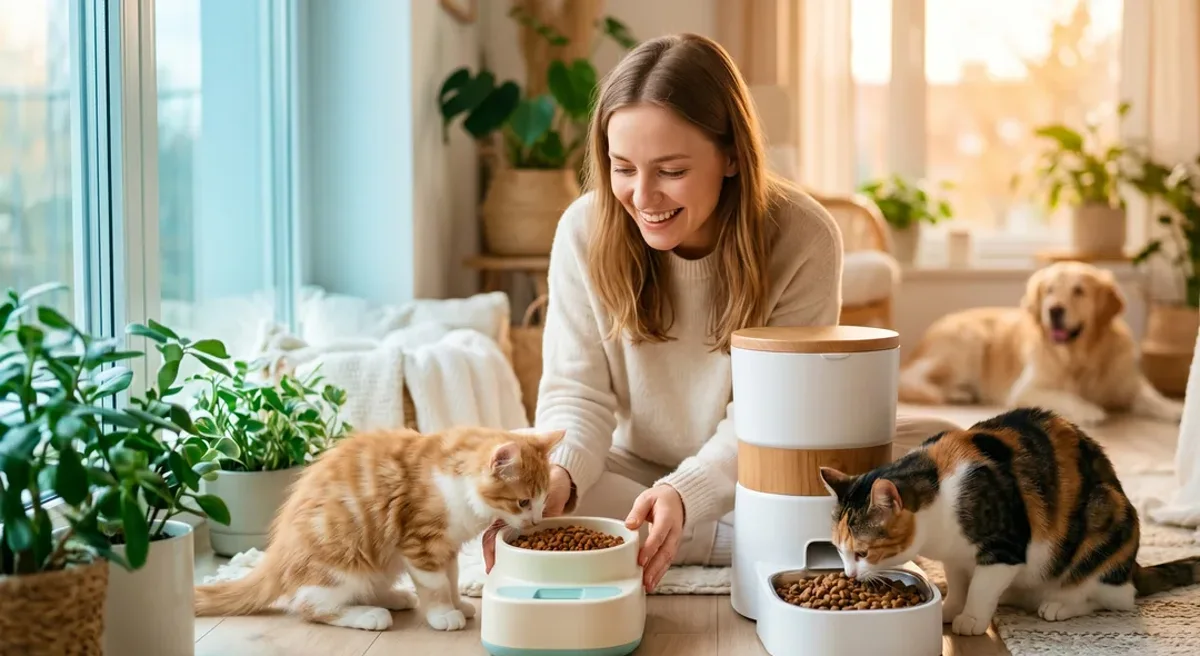
Gravity, timed, tray, and microchip feeders compared
A gravity feeder keeps topping up a bowl as the level falls. It needs no power, but it is not a portion controller. It may suit a cat that reliably self-regulates, while an enthusiastic eater can consume too much too quickly.
A timed hopper dispenses dry food through a motorized rotor. This is the usual choice for multiple scheduled meals. A rotating tray uncovers prefilled compartments and may accept wet food if the manufacturer says so. A microchip feeder opens for one registered pet. It controls access, although it may not schedule meals. Our detailed automatic feeder setup guide explores those mechanisms further.
| Type | Best fit | Food | Main trade-off |
|---|---|---|---|
| Gravity | Reliable grazers | Dry | No timing or portion limit |
| Timed hopper | Scheduled measured meals | Compatible dry kibble | Kibble can bridge or jam |
| Rotating tray | Pre-portioned servings | Dry, some wet | Limited slots and cooling |
| Microchip access | Diet separation | Model dependent | Access control may not include timing |
Build the meal plan before choosing the machine
Start with your cat's daily food allowance, not hopper capacity. Food packages provide a starting point, but age, activity, body condition, neuter status, and health all matter. Cornell's guide to feeding your cat emphasizes life stage, nutritional completeness, and individual needs. Ask your veterinarian to set or review the plan when weight or disease is involved.
Translate the recommended daily calories into grams using the food's calorie statement. The AAFCO explanation of pet food labels helps readers understand calorie content and nutritional adequacy statements. Then subtract treats and food given in enrichment. A cat puzzle toy or treat-dispensing toy can use part of the same daily allowance rather than adding an uncounted extra.
Choose meal times that the household can observe often enough to notice changes. Small scheduled servings can reduce the drama around one large meal, but there is no universal meal count. Kittens, cats with medical conditions, and cats taking food-linked medication need an individual veterinary plan.
Buyer checklist: reliability before smart features
Portion consistency, cleanable food-contact parts, and failure behavior matter more than a camera or recorded voice. Check the manual before buying. Confirm compatible kibble dimensions, minimum portion, schedule memory, battery type, bowl material, dishwasher guidance, and whether the hopper and rotor can be removed.
A locking lid and protected buttons help with persistent cats. A low-food sensor is useful only if it provides enough warning to act. Jam alerts report what a sensor detected, not necessarily what reached the bowl. Wi-Fi control can be convenient, but scheduled meals should ideally remain stored locally so an internet outage does not erase dinner.
| Feature | Why it matters | Home test |
|---|---|---|
| Repeatable output | Supports the planned allowance | Weigh ten consecutive releases |
| Battery backup | Covers brief outages | Unplug before a test meal |
| Local schedule memory | Works without internet | Disconnect Wi-Fi and observe |
| Removable food path | Makes residue visible and reachable | Disassemble and reassemble once |
| Secure lid and base | Resists tipping and break-ins | Gently push and paw-test it |
| Wide removable bowl | Simplifies inspection and washing | Check access to every surface |
Compare bowl shape separately in our cat bowl guide. A stable, washable bowl and a feeder your cat cannot tip are more valuable than a large advertised capacity that leaves food sitting for weeks.
Food safety for dry and wet meals
Dry kibble is easier to automate, but it is not maintenance free. Protect it from moisture, excess heat, pests, and dirty surfaces. The FDA recommends keeping dry food in its original bag and placing that bag inside a clean, dry container in its pet food storage guidance. Keeping the package also preserves the lot code and best-by date if a recall or quality concern arises.
Load a practical amount, close the hopper fully, and avoid pouring fresh kibble onto greasy crumbs indefinitely. Oils and dust accumulate around rotors and chutes. The FDA's safe handling tips advise washing pet food bowls and utensils after use and washing hands before and after handling food.
Wet food requires a tray specifically designed for it. Cooling inserts can slow warming, but they are not equivalent to a refrigerator. Follow the food label and feeder manual, account for room temperature, and use a conservative holding interval. If a meal must remain safely chilled for a long period, arrange a person to serve it from the refrigerator instead.
Set up, calibrate, and test before relying on it
- Wash first. Clean approved food-contact parts, rinse them, and let them dry completely.
- Choose a dry, level location. Keep the power cord protected and the unit away from litter, direct sun, and water splashes.
- Add backup power. Install fresh batteries if the model supports them, even when using an outlet.
- Use the actual food. Kibble size and shape affect how it moves through a rotor.
- Weigh repeated releases. Record at least ten consecutive portions on a kitchen scale. Use the average and note any missed or double drop.
- Observe a full schedule. Stay home for the first day, verify AM and PM settings, and watch your cat approach the sound.
- Trigger failures safely. Unplug it, disconnect Wi-Fi, and test the schedule. Restore everything afterward.
Introduce the machine beside the normal feeding area without forcing your cat toward it. Start with a supervised release and reward calm investigation. If the motor noise causes fear, increase distance and transition gradually. Never make the untested feeder the only way a cat can access food.
Calibration is not permanent. Repeat it after changing kibble, cleaning the rotor, installing firmware, moving the device, or noticing crumbs and broken pellets. Write the working settings and manual fallback instructions for a caregiver.
Multi-cat homes, kittens, seniors, and medical diets
One timed bowl does not ensure that the intended cat eats. A fast or confident cat may take both portions while a timid housemate waits. Use separate rooms, widely separated stations, or microchip-controlled access, then watch several complete meals. Two open feeders side by side may still invite swapping.
Kittens need growth-appropriate nutrition and closer observation. Seniors may have dental discomfort, arthritis, chronic disease, or changing appetites. A low, accessible station and nonslip route can help some cats, but unexplained weight or appetite changes belong with a veterinarian. The WSAVA Global Nutrition Guidelines support nutritional assessment across life stages rather than choosing food or portions from a gadget alone.
For diabetes, prescription diets, or medication tied to meals, feeder failure carries greater consequences. Get a veterinarian-approved schedule and maintain a human check. A camera view or app notification cannot prove how much the cat swallowed. Keep a simple log of dispensed grams, leftovers, appetite, and body weight trend.
Cleaning routine and common troubleshooting
Follow the manufacturer's cleaning instructions because motor housings and some rotors cannot be immersed. Wash the removable bowl whenever it is soiled, and clean the hopper and food path on schedule or sooner when you see dust, oil, moisture, insects, or odor. Dry every component before adding food. Browse our cat care collection for other household essentials, but use only replacement parts approved for the feeder near the food path.
When output changes, pause the schedule and inspect rather than repeatedly pressing the feed button. Common causes include low batteries, an overfilled hopper, incompatible kibble, food dust, a misaligned rotor, or a blocked chute. If the motor sounds but no food appears, empty the unit and follow the manual. Do not repair food-contact areas with household glue or tape.
Retest after every deep clean, clock change, outage, app update, or extended period of nonuse. Replace damaged bowls, seals, cords, or lids. If food smells stale or your cat suddenly refuses it, discard questionable food, clean the machine, offer a fresh meal, and contact your veterinarian if appetite does not promptly return.
Frequently asked questions
Are automatic feeders good for cats?
They can make meal timing and measured portions more consistent. They work best with a veterinarian-informed daily allowance, regular cleaning, and a person who confirms every day that the cat and machine are doing well.
Can I leave my cat alone for a weekend with an automatic feeder?
No feeder replaces daily care. Arrange a responsible person to check food delivery, fresh water, litter box output, and the cat's behavior. A machine cannot respond to a jam, vomiting, appetite loss, or illness.
Can an automatic cat feeder dispense wet food?
Only use a model designed for wet food. Follow both the pet food label and feeder instructions, use cooling inserts correctly, and keep the holding interval conservative. Refrigeration is safer for longer storage.
How do I measure an automatic feeder portion?
Dispense at least ten portions using the cat's actual food, weigh each one on a kitchen scale, and calculate the average. Repeat after changing kibble because pellet size, shape, and density can alter output.
Will an automatic feeder work if the power or Wi-Fi goes out?
That depends on the model. Prefer battery backup and a schedule stored on the device, then test by unplugging power and disconnecting Wi-Fi before relying on it. Keep written manual feeding instructions as a fallback.
How often should I clean an automatic cat feeder?
Wash the bowl and any visibly soiled surfaces promptly, and clean the hopper and food path on the manufacturer's schedule or sooner when residue, moisture, odor, or pests appear. Dry every part fully before reassembly.
How can automatic feeders work for two cats?
Use separate feeding stations, timed access in separate rooms, or microchip-controlled bowls. Watch several meals to verify that each cat receives the intended food because an open timed bowl cannot prevent stealing.
Conclusion: choose for the failure case
The best feeder is not the one with the longest feature list. It is the one that dispenses your cat's planned amount, handles the chosen food, stays clean, resists break-ins, and fails predictably. Match the mechanism to the problem, calibrate it with a scale, and test power and internet loss while you are home.
Most importantly, keep a person in the loop. Daily observation catches the things automation cannot: a missed meal, a sick cat, stolen food, or a water bowl that tipped overnight. Used within that safety net, a cat pet feeder automatic can make a thoughtful feeding routine easier to follow.
Complete Your Cat Care Station
Explore practical cat accessories with free US shipping.
Browse Cat Accessories →