Top photo: a black and white cat lying on a carpet beside a grey plush toy rat. Photo: Mitch Barrie from Reno, NV, USA / Wikimedia Commons, CC BY-SA 2.0 (cropped, resized and converted to WebP).
If you are looking for the best cat chew toys, this comprehensive guide covers everything you need to know. Whether you are a first-time pet owner or an experienced one looking to upgrade, you will find practical advice, safety tips, and honest comparisons below.
Quick Answer: What Should You Know About Cat Chew Toys?
Cats chew to soothe teething gums, to ease dental discomfort, or out of boredom, so match the toy to the reason: a soft rubber or silicone teether for a kitten, a ridged dental-texture toy for an adult. Skip string, glued-on parts and loose bells, wash chewed toys often, and replace them once they crack or shed. This guide covers each of those, plus the mistakes owners most often make.
Why Cats Chew, and What Cat Chew Toys Are Really For?
Answer: Cats chew for four different reasons, and the right answer depends on which one you are looking at. A kitten cutting adult teeth has sore gums. An adult cat with dental disease chews to relieve discomfort. A bored indoor cat chews because nothing else in the room moves. And some cats chew non-food items persistently.
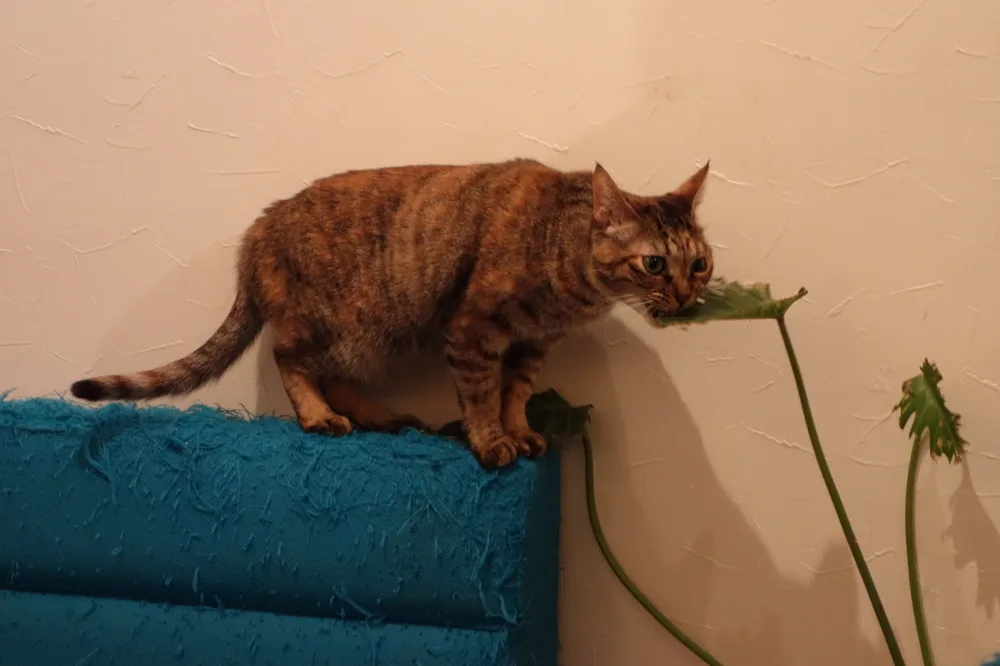
Photo: Yamaguchi Yoshiaki / Wikimedia Commons, CC BY-SA 2.0
Cats chew for four different reasons, and the right answer depends on which one you are looking at. A kitten cutting adult teeth has sore gums. An adult cat with dental disease chews to relieve discomfort. A bored indoor cat chews because nothing else in the room moves. And some cats chew non-food items persistently, which is a behaviour worth discussing with a veterinarian.
A teether is simply a chewable object that is safe to have in a mouth for a long time. That is a narrower definition than most cat toys meet. Something a cat bats across a floor only has to survive a paw, while a teether has to survive sustained grinding without shedding fibres, splitting into pieces, or letting a bell or a plastic eye come loose.
The practical reason to supply one is substitution. A kitten whose gums ache will chew whatever is within reach, and in most homes the nearest chewable items are phone cables, houseplants and your fingers. Putting a purpose-made teether where the kitten already settles redirects that chewing before the cable does, and that is much easier than correcting it afterwards.
What Happens During Kitten Teething and When Cat Chew Toys Help Most?
Answer: Kittens get a set of needle-sharp baby teeth in their first weeks, lose them over the following months, and finish with a full adult set before their first birthday. The loose weeks in the middle are when chewing peaks, when you may find a tiny tooth on the floor, and when a cold teether is.
Kittens get a set of needle-sharp baby teeth in their first weeks, lose them over the following months, and finish with a full adult set before their first birthday. The loose weeks in the middle are when chewing peaks, when you may find a tiny tooth on the floor, and when a cold teether is genuinely welcome rather than just another toy.
Cat parents might also find our cat bowls guide helpful.
Swallowing a shed baby tooth is normal and usually uneventful. What is not normal is a baby tooth still sitting beside the adult one that replaced it, a persistently bleeding gum, a kitten that stops eating, or breath that turns sour. Those are veterinary questions rather than toy questions, and a quick look during a routine visit settles them.
Cold helps more than texture during this phase. Put a clean rubber or silicone teether in the fridge, not the freezer, for a short while before offering it. Chilled rubber soothes an inflamed gum, while frozen-solid rubber is hard enough to bruise one. Rotate two so there is always a cool one ready and the kitten is never left searching for something else to bite.
What Should Pet Owners Know About Different Types of Cat Chew Toys and When to Use Each?
Answer: Soft rubber and food-grade silicone teethers are the workhorses. They flex under a small jaw, they take a chill well, they survive a dishwasher, and they do not shed fibres. Look for a single moulded piece with no glued-on features, thin enough for a kitten to get its back teeth around but far too wide.
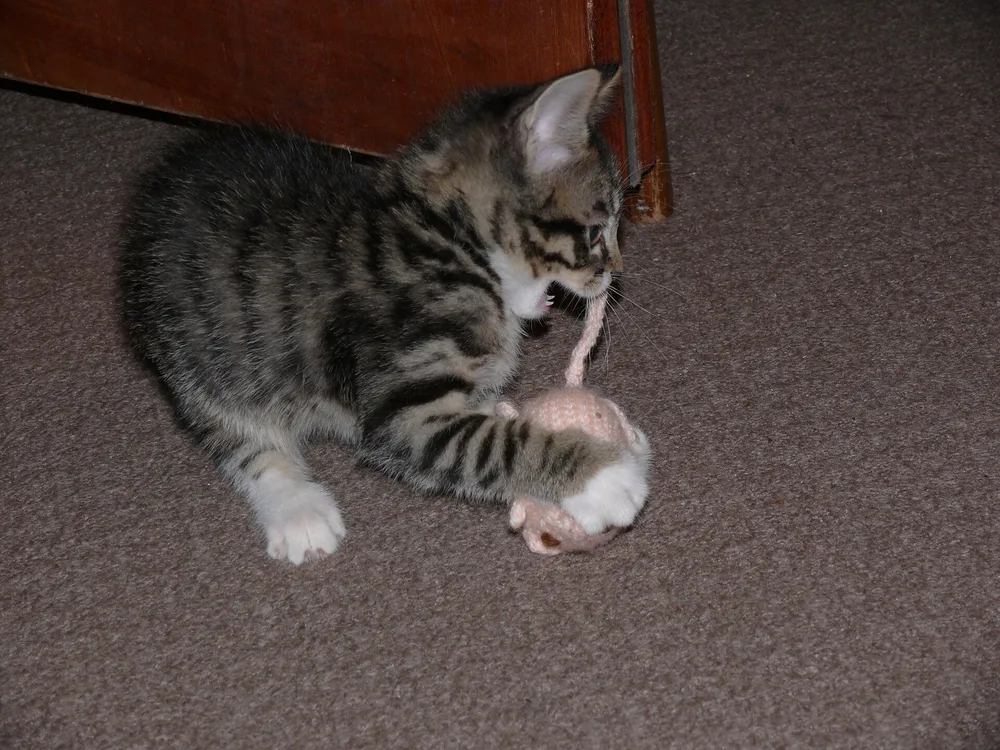
Photo: Andrew Gray / Wikimedia Commons, CC BY-SA 2.0
Soft rubber and food-grade silicone teethers are the workhorses. They flex under a small jaw, they take a chill well, they survive a dishwasher, and they do not shed fibres. Look for a single moulded piece with no glued-on features, thin enough for a kitten to get its back teeth around but far too wide to swallow whole.
Dental chews and dental-texture toys are a different category and they are built for adult cats rather than kittens. The useful ones have a ridged or mesh surface that wipes the tooth as the cat works at it. They are a supplement to brushing and to professional dental care, never a substitute, and a cat with existing dental pain will refuse them for good reason.
Plant sticks, meaning silvervine and matatabi, suit cats who like to gnaw and strip. The cat shaves off the bark, which is the point, so these are a supervised item with a short life rather than a permanent teether. Throw a stick away once it is chewed down to a size that could be swallowed, and skip them entirely for kittens still learning what is food.
Woven fabric strips, braided fleece and tightly sewn kickers cover the soft end. They are satisfying to grip and bunny-kick, and they are also the most likely to come apart. Choose tight weaves with locked stitching and no loose threads, and treat any fraying edge as the end of that toy's life rather than something to trim and carry on with.
What Should Pet Owners Know About Safety Checklist for Cat Chew Toys?
Answer: The rule that matters most has nothing to do with chewing: never leave a cat alone with string, ribbon, tinsel, elastic or any long thread. A swallowed strand catches at one end and the gut keeps trying to move the rest, which is a surgical emergency rather than something to wait out. If you ever.
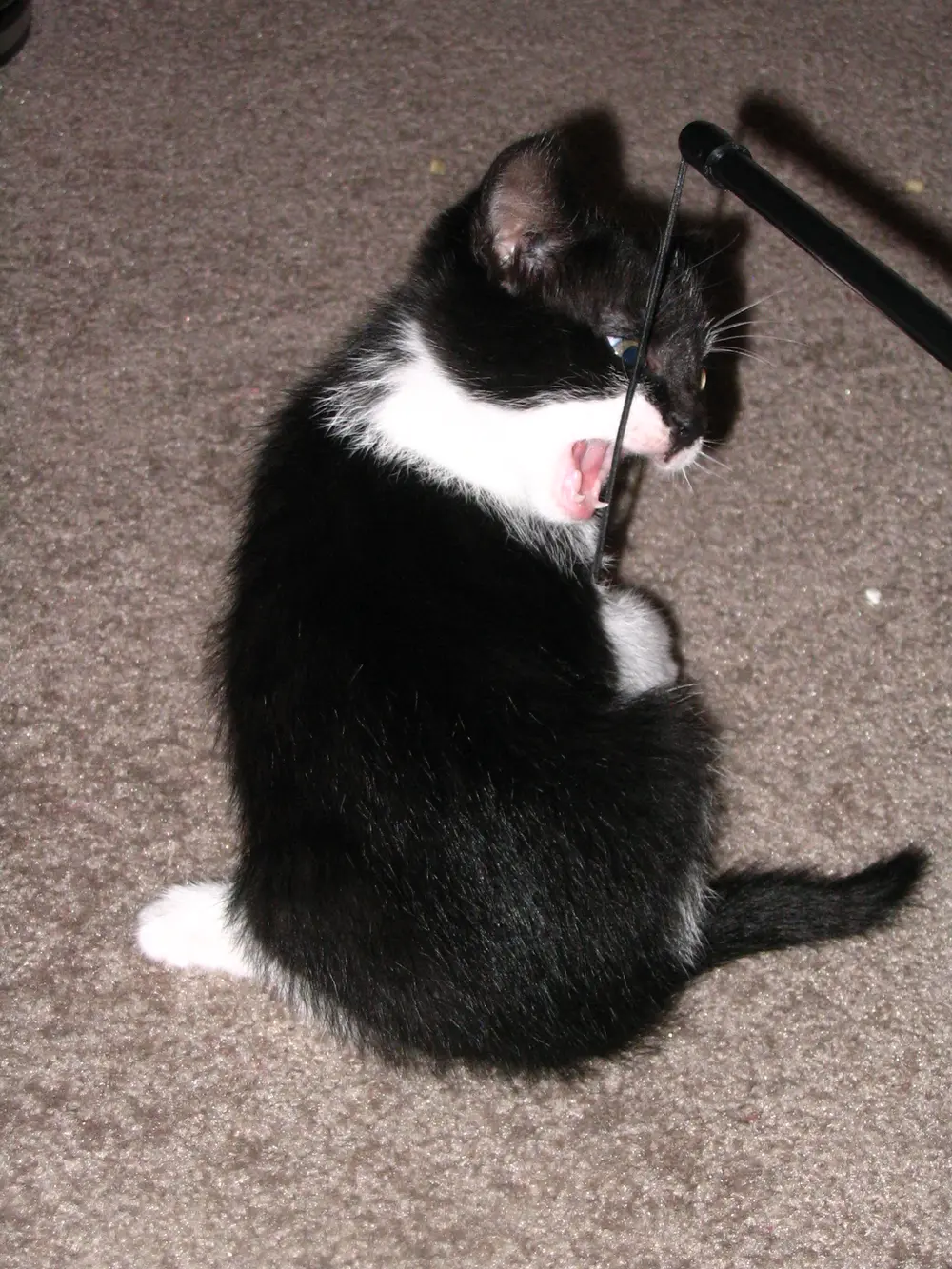
Photo: Dcoetzee / Wikimedia Commons, Public domain
The rule that matters most has nothing to do with chewing: never leave a cat alone with string, ribbon, tinsel, elastic or any long thread. A swallowed strand catches at one end and the gut keeps trying to move the rest, which is a surgical emergency rather than something to wait out. If you ever see thread at a cat's mouth or rear, do not pull it, call your veterinarian immediately.
For more feline-friendly picks, browse our heated cat roundup.
After that, the checklist is short. No glued-on plastic eyes or noses. No bells small enough to come loose. No glitter, foil coatings or painted surfaces on something designed to be mouthed. Nothing small enough to fit entirely inside the mouth. And nothing that sheds fibres when you rub it hard between your fingers, because whatever comes off on your hand is what the cat is swallowing.
Inspect each teether weekly rather than waiting for it to fail. Flex it, look into the seams, and check for splits, thinning patches, exposed stuffing or a chewed-through edge. Replace it at the first real split. Cats are patient enough to work a small flaw into a large one, and a toy that has already lost a piece will lose another.
How to Stop a Cat Biting Hands Instead of Cat Chew Toys?
Answer: Play biting is normal cat behaviour aimed at the wrong target. A kitten that is biting hands has simply learned that hands are the moving thing it is allowed to catch, usually because somebody wrestled with it while it was small and endearing. Punishment does not fix that; it only makes a cat defensive about.
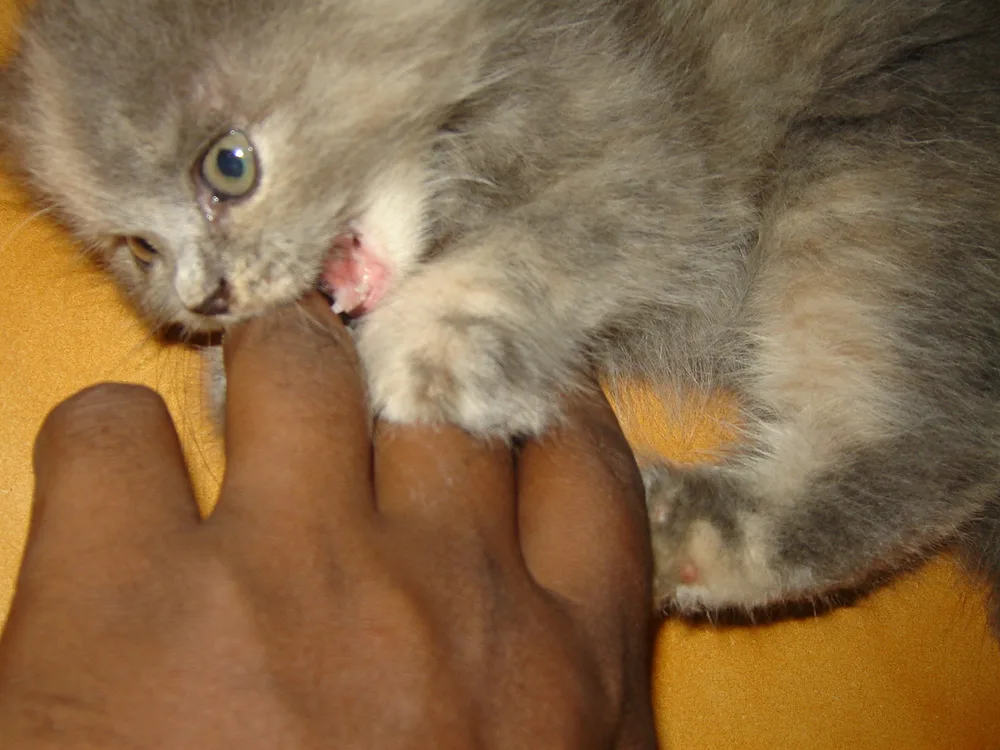
Photo: Aravindan Shanmugasundaram / Wikimedia Commons, CC BY-SA 3.0
Play biting is normal cat behaviour aimed at the wrong target. A kitten that is biting hands has simply learned that hands are the moving thing it is allowed to catch, usually because somebody wrestled with it while it was small and endearing. Punishment does not fix that; it only makes a cat defensive about being touched at all.
The fix is to make hands boring and the legal target obviously better, every single time. When teeth touch skin, the game stops instantly and quietly: stand up, withdraw the hand, wait a moment. Then restart with a wand or a kicker between you, so the biting lands on something it is meant to land on. Cats learn this quickly, and it fails only when one person in the house keeps playing the rough game.
Prevent the arousal that drives ankle ambushes by scheduling real play just before the times your cat usually strikes. A cat that has already chased, caught and spent its biting on a proper toy is not hunting feet. Give it a kicker it can hold with its front paws while biting and rabbit-kicking with the back ones, which is the full sequence and the reason a kicker satisfies a cat that a dangling toy does not.
Watch for biting that is not play. Sudden biting in an adult cat who never did it before, biting that comes with hiding or flinching from touch, or biting during grooming around the mouth, all point at pain rather than manners. Dental disease is the usual culprit and it is easy to miss. Book a veterinary check rather than working on the behaviour, because no amount of training fixes a sore tooth.
How to Clean and Replace Cat Chew Toys?
Answer: Chewed toys get dirty in a way batted toys do not, because saliva and food residue soak into them and then sit there. Rubber and silicone go in hot soapy water or on the top rack of a dishwasher without detergent. Fabric items go in a laundry bag on a gentle wash, with no fabric.
Chewed toys get dirty in a way batted toys do not, because saliva and food residue soak into them and then sit there. Rubber and silicone go in hot soapy water or on the top rack of a dishwasher without detergent. Fabric items go in a laundry bag on a gentle wash, with no fabric softener, because softener leaves a coating that a cat will taste and often reject.
If your cat needs variety, our cat treats guide has great suggestions.
Dry everything completely before it goes back on the floor. A damp fabric teether grows mould inside the stuffing where you cannot see it, and a wet rubber one traps water in its hollows. Keeping two of each means one can dry fully while the other is in use, which is also how you keep a chewing kitten from going back to the cables.
Replace rather than repair. A stitched-up seam on a soft toy will open again in the same place and usually faster. If a teether has split, lost a piece, or thinned enough that you can feel it giving way, it has done its job and the next one should be out of the cupboard before that one goes in the bin.
What Should Pet Owners Know About Common Mistakes Pet Owners Make with Cat Chew Toys?
Answer: Handing a cat a dog toy is the most common error and the least obvious. Dog chews are sized for a much bigger jaw, built from harder rubber than a cat can usefully work, and often finished with coatings aimed at a dog's palate. A cat cannot get purchase on them, so the cat goes.
Handing a cat a dog toy is the most common error and the least obvious. Dog chews are sized for a much bigger jaw, built from harder rubber than a cat can usefully work, and often finished with coatings aimed at a dog's palate. A cat cannot get purchase on them, so the cat goes back to the cable and the owner concludes that cats do not chew.
The second is leaving everything out all the time. A cat that has seen the same toy on the same patch of floor for a month stops registering it entirely. Keep a small handful in rotation, swap part of the set every few days, and keep the chewables you worry about for supervised sessions rather than permanent access.
The third is treating chewing as naughtiness. Sustained chewing of fabric, wool or plastic in an adult cat is worth investigating rather than scolding, because dental disease, nausea and anxiety all show up this way. Scolding teaches the cat to do it out of sight, which removes the only information you had.
The fourth is assuming a cat that has stopped biting its toys has simply grown out of it. Cats who lose interest in gnawing often do so because the teether on offer went hard, went sour, or stopped being interesting, not because the urge went away. If the biting has moved somewhere you cannot see, you will usually find the evidence on a cable or a plant leaf before you find it on a toy.
What Should Pet Owners Know About Getting the Best Value When Shopping for Cat Chew Toys?
Answer: Buy fewer, better, and in pairs. One well-made silicone teether plus one tightly sewn kicker covers almost every household, and having a second of each means rotation and drying time are effortless. A bag of a dozen cheap fabric mice looks like value until you count how many have lost an eye within a week.
Buy fewer, better, and in pairs. One well-made silicone teether plus one tightly sewn kicker covers almost every household, and having a second of each means rotation and drying time are effortless. A bag of a dozen cheap fabric mice looks like value until you count how many have lost an eye within a week.
Spend on construction rather than appearance. Moulded single-piece rubber, locked stitching, tight weaves and no applied decoration are the features that decide whether a toy is safe in a month. Colour, printed patterns and novelty shapes are what the packaging sells and have no bearing on how it holds up.
Some of the best options cost nothing. A tightly braided strip cut from an old fleece blanket, knotted hard at both ends, makes an excellent supervised kicker and goes straight in the wash. Keep those for sessions you are watching, and keep the bought toys for the times your cat is alone. Our cat toy range covers the interactive side when you want something made for the job.
If you want to dig deeper into the research, the ASPCA cat care library publishes practical, expert-reviewed resources for pet owners.
What Questions Do Pet Owners Ask About Cat Chew Toys?
Answer: Cats chew to soothe teething gums, to ease dental discomfort, or out of boredom, so match the toy to the reason: a soft rubber or silicone teether for a kitten, a ridged dental-texture toy for an adult. Skip string, glued-on parts and loose bells, wash chewed toys often, and replace them once they crack or shed. This guide covers each of those, plus the mistakes owners most often.
Do cats need chew toys like dogs do?
Not in the same way, but many cats benefit. Kittens chew hard while they are losing baby teeth, and bored indoor cats chew whatever is available, which in most homes means cables and houseplants. A safe chewable gives that behaviour somewhere harmless to go. Cats do not need the heavy rubber chews made for dogs and usually cannot use them.
When do kittens teethe and how long does it last?
Kittens get needle-sharp baby teeth in their first weeks, start losing them within a few months, and finish with a full adult set before their first birthday. The middle stretch is when chewing peaks. Swallowing a shed tooth is normal, but a baby tooth still sitting beside its adult replacement is worth mentioning at the next veterinary visit.
Is it safe to give a kitten a chilled chew toy?
Yes, chilled is good and frozen is not. A short spell in the fridge makes rubber cool enough to soothe an inflamed gum while staying soft. Frozen solid rubber is hard enough to bruise. Keep two in rotation so a cool one is always ready, and wash each one before it goes back in.
Why does my cat chew on cables, plastic and wool?
Boredom and dental discomfort are the usual causes, and some cats chew non-food items persistently for reasons that need a veterinary look. Cover or reroute cables first, because the electrical risk is immediate. Then add real play sessions and a safe chewable, and book a check if the behaviour is new, intense, or paired with appetite changes.
How do I stop my kitten biting my hands?
Stop making hands part of the game. When teeth touch skin, end the session quietly and withdraw, then restart with a wand or kicker between you so there is a legal target. Be consistent across everyone in the house, and play before the times your kitten usually ambushes you, since a cat that has already hunted is not looking for ankles.
Are string, ribbon and feather toys safe for cats?
Only while you are holding the other end. A swallowed strand of string or ribbon catches at one end while the gut keeps moving the rest, and that is a surgical emergency rather than something to watch and wait on. Put wands and anything with a cord away between sessions, and never pull on thread you can see at either end of a cat.
Can a chew toy clean my cat's teeth?
It can help a little and it is not a substitute for anything. Textured dental toys wipe some surface film from the teeth a cat actually uses on them, which is a minority of the mouth. Brushing and professional dental care do the real work. A cat refusing a dental toy may already be in pain, which is worth a veterinary look.
How often should I replace a cat's chew toy?
At the first genuine split, fray or missing piece, not at a fixed interval. Check each one weekly by flexing it and looking into the seams, and throw away anything shedding fibres on your fingers. Plant sticks such as silvervine are meant to be chewed down, so bin them once they shrink to a swallowable size.