A puzzle toy is a food-delivery problem your dog has to solve. Done well, it turns a two-minute meal into twenty minutes of focused work and leaves a dog genuinely settled afterwards. Done badly, it produces a dog that gives up in thirty seconds and never touches the thing again. The difference is almost entirely about difficulty and introduction, not about which brand you bought.
What Puzzle Feeding Actually Does for a Dog
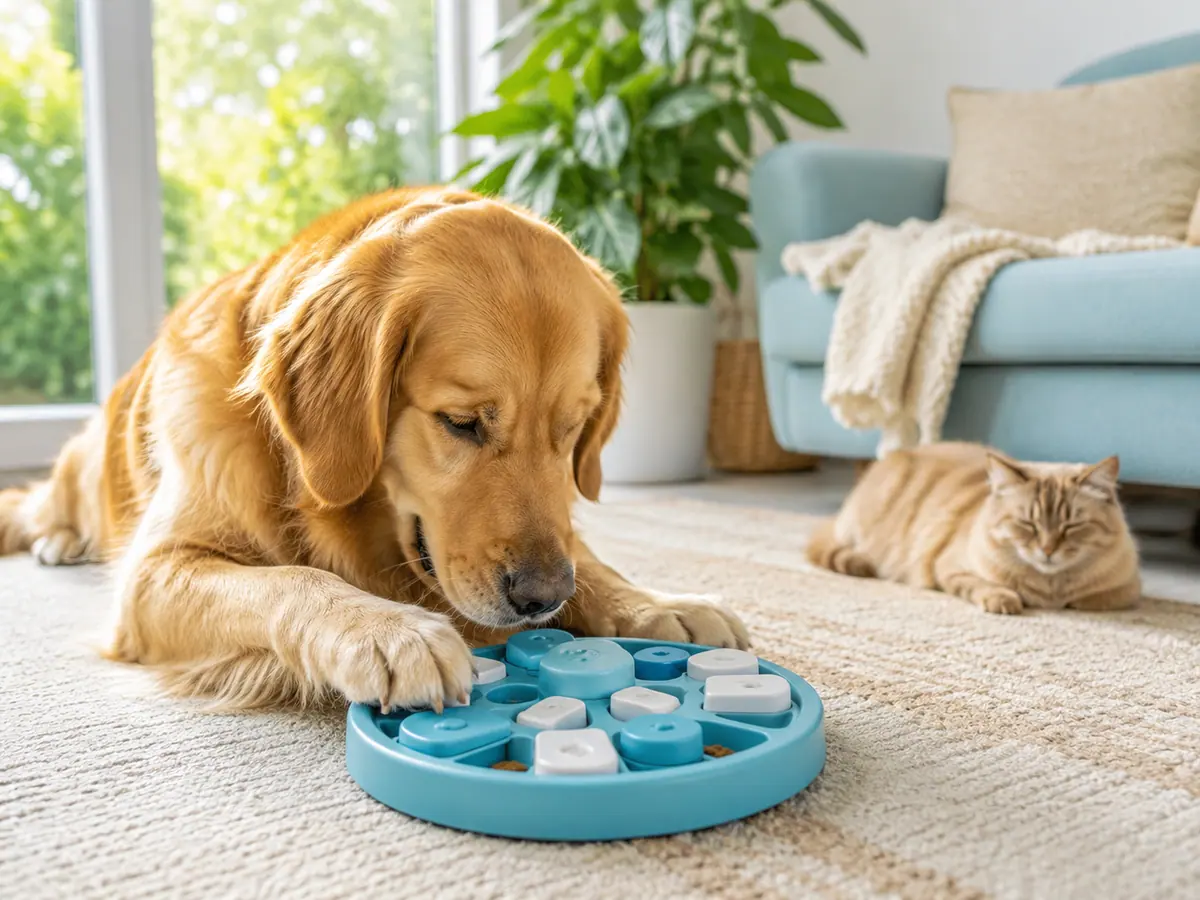
Dogs are built to work for food. Sniffing out, manipulating, and extracting a meal engages problem solving and scent work in a way that a bowl never does, and the effect afterwards is what owners notice first: a dog that lies down and stays down rather than one that finishes eating and immediately starts looking for something to do.
Slowing the meal down has a second, more practical benefit. A dog that inhales a bowl in forty seconds swallows a lot of air with it, and puzzle feeders reliably stretch that out. For fast eaters, this is often the reason an owner buys the first puzzle and the reason they keep using it.
The third effect is on the owner. Puzzle feeding gives you something structured to do with a dog on a rainy day, during crate rest, or when a walk is not possible. It is not a replacement for exercise or training, but it fills the gap that otherwise gets filled by a bored dog inventing its own project.
The Main Formats and What Each One Is Good At
Treat-dispensing balls and stuffable rubber toys are the beginner category. The dog rolls, licks, or chews and food falls out, and the mechanism is obvious enough that almost every dog succeeds within a minute. These are the right first purchase and the right choice for unsupervised time, because there are no removable pieces.
If you want even more options, check out our guide to dog cones.
Sliding and lifting puzzle boards are the middle category. The dog moves a cover, lifts a lid, or spins a disc to expose a compartment, which requires deliberate paw and nose work rather than brute force. These need supervision, because the moving parts are removable and a frustrated dog will try chewing the board instead of solving it.
Snuffle mats and scatter feeders sit slightly apart from the others. Instead of a mechanism, they hide food in fabric folds or grass-like fibre so the dog has to search by scent. They are the gentlest option, they suit anxious or senior dogs particularly well, and they are the easiest to make difficult again by simply scattering less food over a larger area.
Safety Rules That Matter With Puzzle Toys
Size the toy to the dog, not to the room. Any object a dog can fit entirely into its mouth is a choking risk during unsupervised play, and puzzle boards designed for small breeds have small parts that a large dog can swallow whole. When in doubt, go one size up.
Supervise anything with moving parts, every time. Sliders, pegs, and lids are the components that get chewed off when a dog decides the shortcut is faster than the solution. Put multi-part puzzles away between sessions and reserve solid, one-piece toys for time alone.
Inspect and clean on a schedule. Food residue in a puzzle toy goes rancid faster than most owners expect, especially in warm weather and especially with wet food or peanut butter. Wash after each wet-food session, check for cracks and tooth marks weekly, and retire anything that has started to split, because a cracked edge is a sharp edge.
Matching Puzzles to Age and Ability
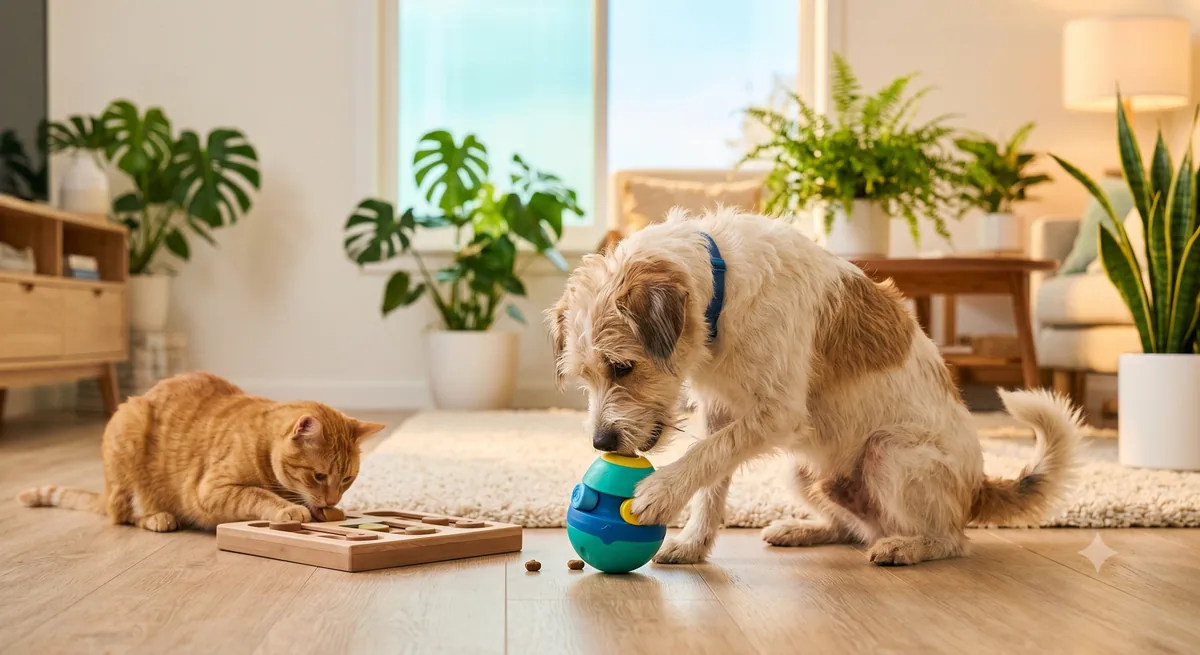
Puppies need easy wins and soft materials. A puzzle that takes an adult dog ten minutes will simply be abandoned by a twelve-week-old, and hard nylon puzzles are inappropriate for teething mouths. Start with a stuffable rubber toy filled loosely enough that food falls out on the first nudge, then tighten the packing as the puppy improves.
You might also enjoy our recommendations for tough dog toys.
Adult dogs are where difficulty becomes interesting. Once a dog solves a puzzle in under two minutes consistently, it has stopped being enrichment and started being a slightly slower bowl. Increase difficulty by packing more tightly, freezing wet fillings, or moving up to a multi-step board rather than by buying a second toy at the same level.
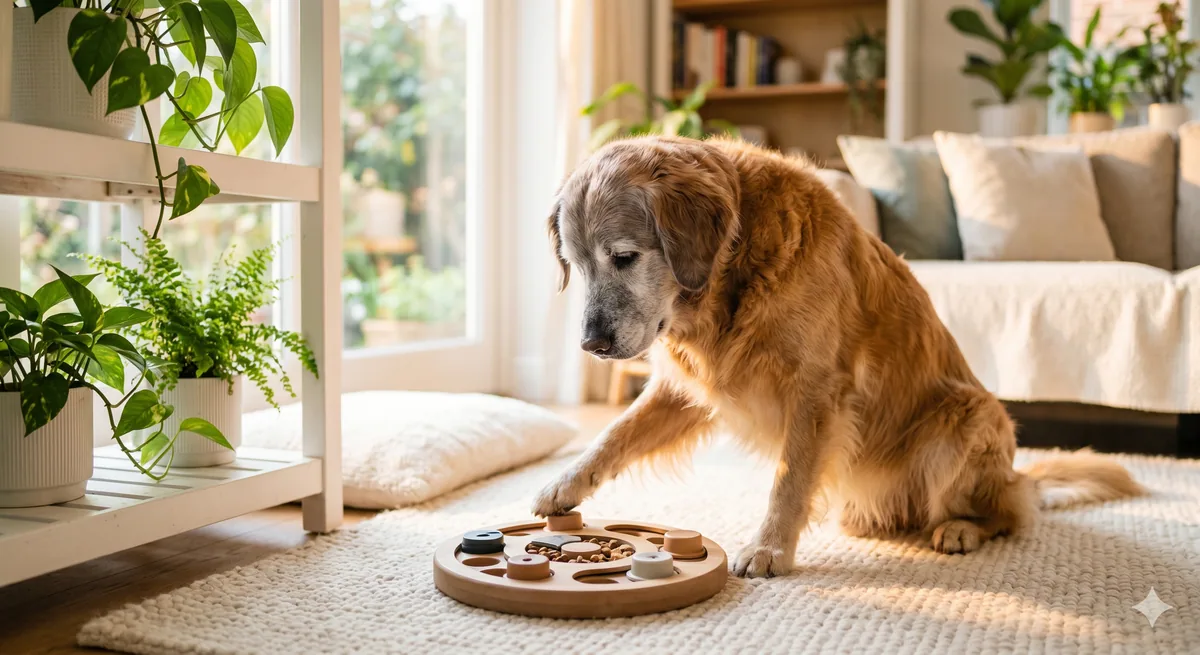
Senior dogs often need the difficulty pulled back rather than pushed forward, and they need it for reasons that are easy to miss. Reduced jaw strength, stiffer shoulders, and dimmer sight all make a formerly easy puzzle frustrating. Snuffle mats and shallow lift-lid boards keep the scent work without requiring force.
How to Introduce a Puzzle Without Creating Frustration
Make the first session almost too easy. Leave the lids off, leave the sliders open, and let your dog take food straight from the compartments so the object becomes associated with success. Owners who present a fully loaded puzzle on day one usually end up with a dog that avoids it permanently.
Use part of the daily food ration rather than extra treats. Puzzle feeding is most sustainable when it replaces the bowl for one meal, and it avoids the weight gain that comes from adding twenty minutes of treats to an already complete diet. Measure the portion out, then load the puzzle from it.
Watch for the give-up signal and intervene before it arrives. A dog that walks away, starts chewing the board, or barks at it has passed the point where the puzzle is enjoyable. Help by tipping the toy, opening one compartment, or reducing the packing, and end the session while your dog is still engaged rather than after it has failed.
The Errors That Turn a Good Puzzle Into Clutter
Jumping straight to the hardest board on the shelf. Difficulty ratings on packaging are aspirational, and a dog that has never used a puzzle before will not decode a three-step mechanism unaided. Every level you skip increases the odds of a permanent avoidance.
For related picks, take a look at our toy poodle roundup.
Leaving multi-part puzzles down all day. Novelty is most of the value, so a board that is always available becomes furniture within a week, and an unsupervised board is also the one that loses a slider to a bored mouth. Ten focused minutes then put away beats all-day access.
Ignoring the calorie arithmetic. Puzzle toys are usually loaded with high-value food because it holds attention, and a daily filling of peanut butter or cheese adds up quickly on a small dog. Subtract what goes into the puzzle from the daily ration rather than treating it as free.
Getting Value Without Buying a Shelf of Toys
One solid stuffable toy plus one snuffle mat covers most of what a household needs. Between them you get an unsupervised option and a scent-work option, and both can be made harder indefinitely by changing how you load them. A third and fourth purchase usually adds variety rather than capability.
Rotation is free difficulty. Keeping two or three puzzles out of sight and swapping them every few days restores most of the novelty that made the first session interesting, which is cheaper and more effective than buying a new toy every time interest fades.
Some of the best puzzles cost nothing. A folded towel with kibble rolled inside, a muffin tray with treats under tennis balls, or food scattered across a lawn all produce genuine scent work. Use these to test whether your dog enjoys puzzle feeding at all before committing to an expensive board.
What to Check Before You Buy
Check how it comes apart for cleaning. A puzzle with a sealed cavity that traps wet food is a puzzle you will stop using by the second month. Dishwasher-safe or fully openable designs survive real households; clever mechanisms that cannot be rinsed do not.
Check the material against your dog’s chewing style. Hard nylon and heavy rubber suit determined chewers, moulded plastic boards suit dogs that solve rather than destroy, and fabric snuffle mats suit gentle mouths only. Buying a plastic board for a power chewer is a short and expensive relationship.
Finally, check the difficulty is adjustable. The best puzzles let you change how tightly food is packed, whether it is frozen, or how many compartments are loaded. A toy with exactly one difficulty setting has a short useful life no matter how good that setting is.
Canine Puzzle Toys: Feature Comparison
The table below compares the three puzzle formats most households end up choosing between, so you can match the format to your dog rather than to the packaging.
Frequently Asked Questions
Are puzzle toys good for all dogs?
Most dogs benefit, but the format has to match. Anxious and senior dogs usually do better with snuffle mats and scent work than with mechanical boards, and power chewers need durable rubber rather than moulded plastic. A dog that consistently gives up is being asked the wrong question, not failing.
How long should a puzzle session last?
Ten to twenty minutes of focused work is plenty for most dogs. The aim is to end while your dog is still interested, because sessions that run until frustration teach avoidance rather than persistence.
Can a puzzle toy replace a walk?
No. Puzzle feeding provides mental work, not physical exercise or the outdoor stimulation of a walk. It is a useful supplement, and it is genuinely valuable during crate rest or bad weather, but it sits alongside exercise rather than replacing it.
What should I put in a puzzle toy?
Use part of the daily food ration wherever possible, with a small amount of higher-value food to hold interest. Dry kibble and small training treats work in almost any design; wet fillings hold attention longer but require washing after every session.
My dog destroys puzzle toys. What now?
Move to one-piece durable rubber and drop the mechanical boards entirely. Destruction usually means either the puzzle is too hard, so chewing became the shortcut, or the material was never rated for that bite strength. Reduce difficulty first, then reassess the material.
How often should I clean a puzzle toy?
After every session that involved wet food, and at least weekly for dry food. Residue in crevices spoils faster than most owners expect, and a puzzle that smells is one the dog will start refusing.
Are puzzle toys safe to leave with a dog alone?
Only one-piece designs with no removable parts, and only if the toy is too large to be swallowed. Sliding boards, pegs, and lids should be supervised, then put away between sessions.