This is not a buying guide. If you have landed here after a dog dragged you down a street or bolted after a deer, the question worth answering is not which bark collar to pick, but whether the problem in front of you is one this equipment can honestly solve. Below is what these tools physically do, what the evidence and the main welfare bodies say about them, how they are fitted by the people who do use them, and what addresses the same problem without them.
Quick Answer: What Should You Know About Bark Collar?
Prong and remote collars work by applying discomfort, so the honest answer is not which to buy. Most pulling and recall problems respond better to a front-clip harness, a fixed-length lead and reinforcement-based training. Several countries restrict these devices. If you are considering one, speak with a qualified behaviourist and your veterinarian first.
Why Pulling and Recall Problems Send Owners Toward Bark Collar?
Answer: Almost nobody starts here. Owners arrive after a dog has dragged them down a street, bolted after a deer, or barked at every passing stranger, and after the gentler things they tried stopped working. That is a real problem, and it deserves a straight answer rather than a sales pitch in either direction.
Almost nobody starts here. Owners arrive after a dog has dragged them down a street, bolted after a deer, or barked at every passing stranger, and after the gentler things they tried stopped working. That is a real problem, and it deserves a straight answer rather than a sales pitch in either direction.
So here is the straight answer. These are aversive tools. They are designed to work by adding something the dog wants to avoid, so that the behavior stops to make the unpleasant thing stop. That is not a slur on anyone who owns one; it is simply what the mechanism is, and any guide that will not say it plainly is not telling you enough to make a decision.
They often do stop a behavior quickly, and that is exactly why they sell. It is also why the risks are easy to miss. A dog that stops pulling on Tuesday looks like a solved problem, and the costs, if there are any, turn up weeks later in a form that does not obviously connect back to the collar.
The rest of this guide covers what each tool physically is, how it is fitted when it is used, what can go wrong, what the veterinary and behavior professions say about aversive equipment, and what a front-clip harness plus reinforcement-based training does about the same pulling problem. Livehappypet does not sell prong or electronic collars, so nothing here is written to move a product.
What Should Pet Owners Know About Different Types of Bark Collar and How Each Is Meant to Work?
Answer: A prong collar is a ring of blunt metal links whose inward tips close against the neck when the lead goes tight. A remote collar is a box strapped against the skin that delivers a tone, a vibration or a static pulse when a handler presses a transmitter. Both add something unpleasant.
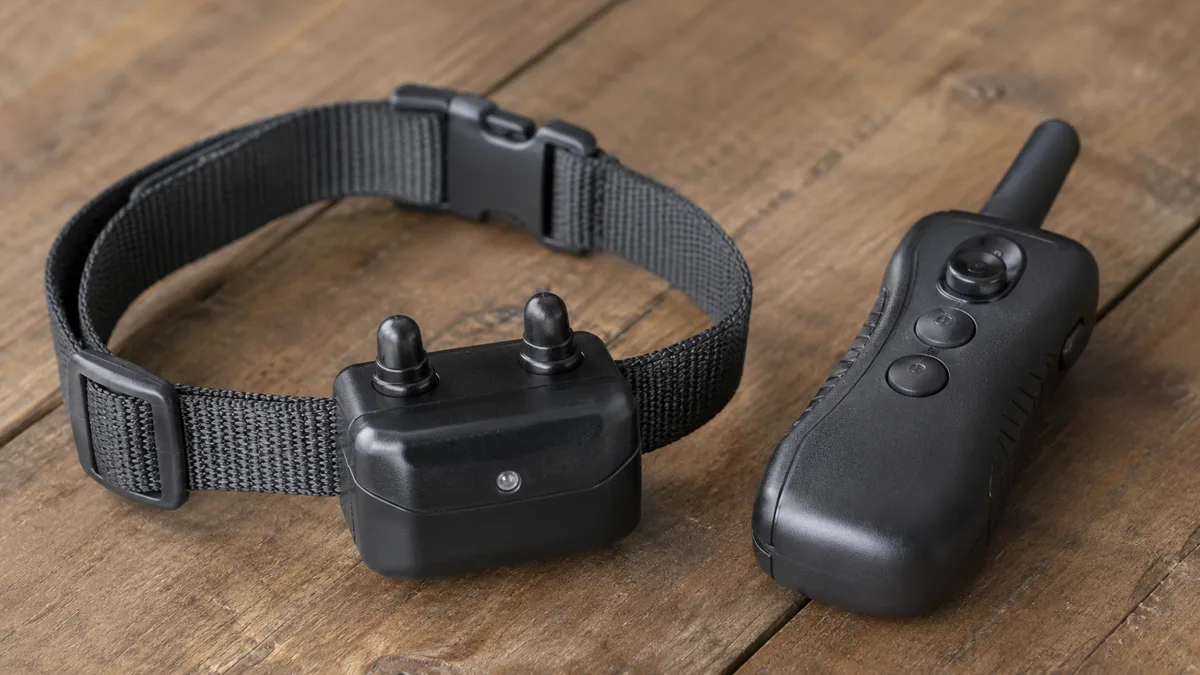
A prong collar is a ring of blunt metal links whose inward tips close against the neck when the lead goes tight. A remote collar is a box strapped against the skin that delivers a tone, a vibration or a static pulse when a handler presses a transmitter. Both add something unpleasant.
For more expert recommendations, check out our leash guide.
The prong, also sold as a pinch collar, is sized by adding or removing links rather than by sliding it looser, and it is meant to sit high and close with no slack. Most have a short chain section at the back so the loop can only close so far. The marketing line that it imitates a mother dog correcting a puppy is a story, not an observed fact, and the claim that it is gentler because pressure is spread around the neck is only true relative to a choke chain, which is a very low bar. The best known manufacturer is the German hardware firm Herm Sprenger, which is why that name appears in so many searches; better machining changes the finish and the fit, not the mechanism.
Remote collars, sold as electronic, e-collars, shock collars or stimulation collars depending on who is writing the listing, come as a receiver with two contact posts and a handheld transmitter with a level dial. Most offer a tone and a vibration as well as a static pulse. Close relatives fire with no handler at all: a bark collar triggers on throat vibration or sound, and a containment collar triggers on a buried wire or a satellite boundary. Those automatic versions remove the one safeguard that matters most, which is a person deciding whether this particular moment is what they meant to mark.
Two things often confused with this category are not in it. A martingale is a fabric loop with a short secondary loop that tightens to a fixed limit and then stops, designed so a narrow-headed dog cannot reverse out of its collar. A head halter steers from the muzzle. Neither is designed to hurt. A choke chain and a slip lead used as a correction device, on the other hand, belong squarely in this category even though they look like ordinary walking gear.
What Should Pet Owners Know About Fitting and Handling Rules That Apply to Bark Collar?
Answer: When these tools are used, the fitting rules are strict. Both sit high on the neck, just behind the ears and under the jaw, snug enough that they do not rotate. Neither goes on a puppy, neither is left on an unsupervised dog, and neither is ever clipped to a tie-out.
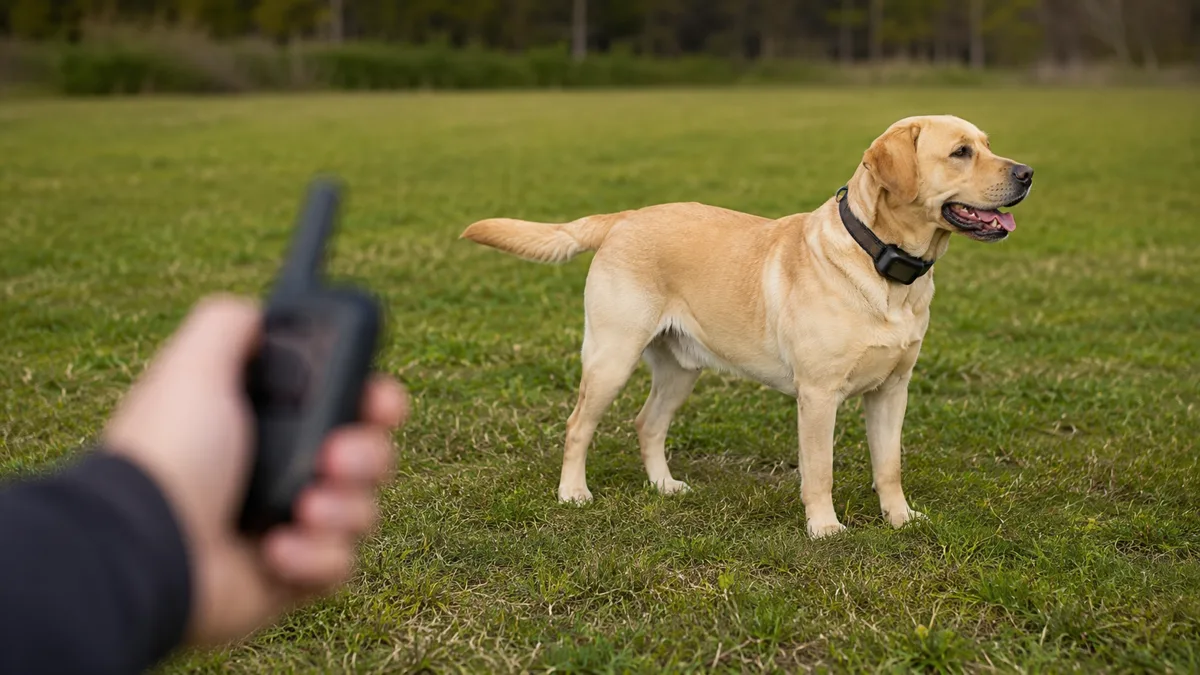
When these tools are used, the fitting rules are strict. Both sit high on the neck, just behind the ears and under the jaw, snug enough that they do not rotate. Neither goes on a puppy, neither is left on an unsupervised dog, and neither is ever clipped to a tie-out.
A prong is fitted by taking links out until the closed loop sits high and level without hanging, and it is put on by unhooking a link rather than dragged over the ears. It should never be attached to a retractable lead, never left on in the house, never used to haul a dog along, and never clipped to a second dog, a bike or a post. Links can spring open under a hard jerk, which is why anyone who uses one is also expected to run a backup connection to a flat collar.
A remote receiver has to make contact through the coat without being cranked down, which is the single hardest thing about it. Too loose and it does nothing, or it chatters against the skin; too tight and the posts press a sore into the neck. The standing advice from people who use them is to rotate its position, take it off between sessions, and never leave it on a dog that is lying down all day, swimming, or sleeping. Charge it and test it yourself before the dog wears it, so you know what each level actually does.
The part that decides everything, though, is timing, and it is the part a product cannot supply. A dog learns what was happening at the moment the sensation arrived, not what you intended to correct. If the pulse or the pinch lands a second late, or lands while the dog is looking at a child, a cyclist or another dog, that is what the dog associates it with. Nothing fitted correctly fixes bad timing, and nothing should ever be used in frustration.
What Can Go Wrong with Bark Collar?
Answer: The physical risks are the obvious ones: pressure sores where contact posts sit, abrasion or puncture from links, and a link that opens under load. The behavioral risks are harder to see and usually matter more, because they appear weeks later and look like a completely different problem.
The physical risks are the obvious ones: pressure sores where contact posts sit, abrasion or puncture from links, and a link that opens under load. The behavioral risks are harder to see and usually matter more, because they appear weeks later and look like a completely different problem.
You might also find our collars article helpful when shopping.
The first is fallout, sometimes called misassociation. A dog corrected while it is staring at another dog can learn that other dogs predict pain. A dog corrected as a child runs past can learn the same thing about children. The pulling may stop and a reactivity problem may start, and because the two events are weeks apart almost nobody connects them.
The second is redirection. A dog that is startled or hurt may turn on whatever is closest, and what is closest is usually the lead, the other dog on the walk, or the hand of the person holding it. This is not spite and it is not the dog being bad. It is an ordinary reaction to a sudden unpleasant event with no clear source.
The third is suppression, which is the one that worries behavior professionals most. Growling, stiffening and backing away are warnings, and warnings are useful. A dog that is punished for growling can learn that growling is dangerous to do, while remaining exactly as frightened as it was. The outward signs go quiet and the underlying fear does not, which is how owners end up describing a bite as coming out of nowhere. It did not come out of nowhere; the early part of the sentence was removed.
The fourth is quieter still. Training that runs on avoidance tends to produce a dog that offers less of everything, because doing nothing is the safest option. A calm dog and a shut-down dog can look very similar from the outside, and you cannot tell from a video which one you are watching.
What Veterinary and Behavior Organizations Say About Bark Collar and Similar Equipment?
Answer: The main veterinary behavior organizations in the United States and Europe have published position statements that point the same way: reward-based methods first, and aversive equipment avoided or left to a qualified professional. Read those statements on the organizations' own websites rather than a retailer's summary of them.
The main veterinary behavior organizations in the United States and Europe have published position statements that point the same way: reward-based methods first, and aversive equipment avoided or left to a qualified professional. Read those statements on the organizations' own websites rather than a retailer's summary of them.
Their reasoning is not that corrections never stop behavior. It is that the risks described above are carried entirely by the dog, that they are hard to detect until they are serious, and that the same results are reachable without them. Groups such as the American Veterinary Society of Animal Behavior publish their guidance publicly, as do several national veterinary associations and the main professional training bodies, and their documents are short enough to read in an evening.
The law has moved in the same direction in a number of places. Several European countries and some Australian states restrict or ban electronic collars outright, and prong collars are prohibited or heavily restricted in parts of Europe as well. The rules differ by country, by state and sometimes by competition organization, and they keep changing, so check your own local legislation before buying anything and check again before you travel or compete.
There is a practical version of all this for choosing a trainer. If the first answer to your problem is a piece of hardware, get a second opinion. Ask any trainer directly what happens when the dog gets it right and what happens when the dog gets it wrong. A professional who cannot or will not answer the second half of that question has already told you something.
How a Front-Clip Harness and Loose-Lead Training Solve the Problem Behind Bark Collar?
Answer: Pulling is a mechanical problem and a training problem at once, so it takes two answers. A well-fitted front-clip harness changes the mechanics today by moving the lead attachment to the chest, so a lunge turns the dog toward you instead of tightening on the throat. Training changes the habit over the following weeks.
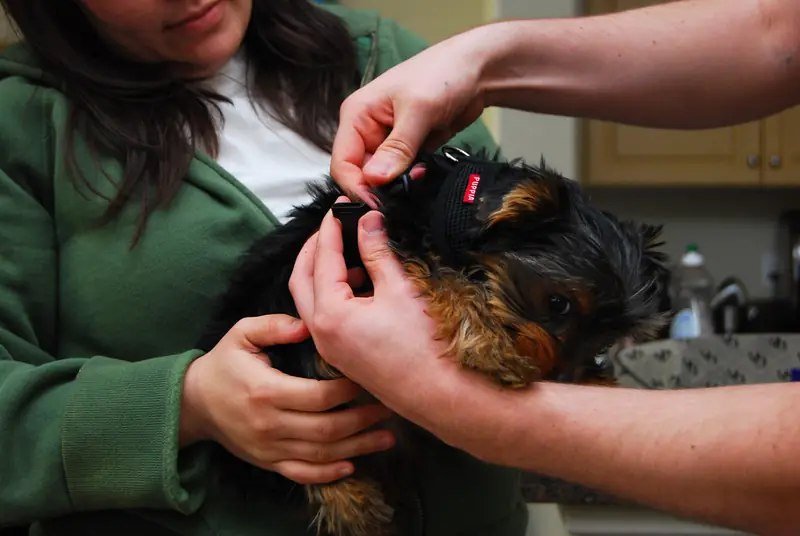
Pulling is a mechanical problem and a training problem at once, so it takes two answers. A well-fitted front-clip harness changes the mechanics today by moving the lead attachment to the chest, so a lunge turns the dog toward you instead of tightening on the throat. Training changes the habit over the following weeks.
Looking for more options? Our e collar roundup covers additional top picks.
Fit is what makes a harness work or fail. Look for a Y-shaped front that sits on the sternum and clears the point of the shoulder, so the dog's stride is not blocked, and check two fingers flat under every strap with nothing cutting into the armpit. A double-ended lead clipped to both the chest ring and the back ring gives real steering, because you can turn the front of the dog without pulling on anything. A badly fitted harness that slips sideways will teach you nothing except that harnesses do not work.
The training half is less complicated than it sounds, and it is mostly about what you pay for. Reinforce the position you want rather than punishing the one you do not: when the lead is loose, the walk continues and good things happen beside your leg; when it goes tight, everything stops until it softens. Pay generously near the things that are hard, keep sessions short, and practice where the dog can actually think before you try the busy street. Recall is built the same way, on a long line, with food or a toy the dog genuinely wants, and by never calling a dog to do something it dislikes.
Most of what looks like a training failure is an exercise and sleep failure. A dog that has not had a chance to run, sniff and rest properly will pull like a freight train no matter what is around its neck. Sniffing walks on a long line in open ground, something to chew at home, and an undisturbed place to sleep do more for lead manners than any piece of equipment. When you are ready to set that up, our collars, leads and harnesses cover the equipment side of it.
When to Involve a Qualified Behaviorist Instead of Buying Bark Collar?
Answer: Growling, snapping, lunging at people or dogs, guarding food or objects, and panic when left alone are not equipment problems. They are emotional ones, and hardware that suppresses the outward signs makes them harder to read. Those cases want a qualified behavior professional, and often a veterinary examination first.
Growling, snapping, lunging at people or dogs, guarding food or objects, and panic when left alone are not equipment problems. They are emotional ones, and hardware that suppresses the outward signs makes them harder to read. Those cases want a qualified behavior professional, and often a veterinary examination first.
Start with your veterinarian, genuinely. Pain changes behavior, and a dog that has become grumpy, reactive or suddenly unwilling to walk may be telling you about its joints, its ears, its teeth or its gut rather than about its training. Ask for a physical examination before any behavior plan, and ask whether a referral to a veterinary behaviorist is available in your area.
When you choose a trainer, ask three questions before you book. What will you do when my dog gets it right? What will you do when my dog gets it wrong? What qualification or assessment stands behind that? Ask to watch a session before your dog is in it. Be wary of anyone who guarantees a result, who talks about dominance and being the pack leader, or who wants your dog taken away for a residential program you cannot observe.
The honest order of operations is diagnosis first, then management, then training, and hardware last if at all. Buying equipment before anyone has worked out why the dog is doing what it does is how owners end up with a drawer full of gear and the same problem. Put the money toward a professional pair of eyes on the actual dog.
What Should Pet Owners Know About Common Mistakes Owners Make with Bark Collar?
Answer: The first mistake is buying hardware for a problem nobody has diagnosed. A dog that pulls because it was never taught, a dog that pulls because it is frightened, and a dog that pulls because it never gets to run are three different dogs, and only one of those is a training gap.
The first mistake is buying hardware for a problem nobody has diagnosed. A dog that pulls because it was never taught, a dog that pulls because it is frightened, and a dog that pulls because it never gets to run are three different dogs, and only one of those is a training gap.
The second is leaving things on. A remote receiver worn all day presses on the same patch of skin for hours; a prong left on in the house can catch on a crate, a table leg or another dog. Neither belongs on a sleeping dog, a wet dog, a puppy, or a dog on a tie-out, and neither transmitter should be handed to a child, a visitor or a dog walker who has not been shown what it does.
The third is assuming silence means success. If the barking stopped, the pulling stopped or the growling stopped within a day, ask what the dog is doing instead. A dog that has gone quiet and also stopped greeting people, stopped playing or started avoiding the garden has not learned a new skill. It has learned to do less, and that is worth catching early.
The fourth is the equipment itself. Unbranded remote units with inconsistent output, prong links that have been bent back into shape after springing, and second-hand gear with no manual are all common and all worse than the versions people are imagining. If you have inherited any of it with a rescue dog, you do not have to keep using it. Put a well-made flat collar on the dog for identification, walk it on a properly fitted harness, and get help with the behavior that made someone reach for the hardware in the first place.
If you want to dig deeper into the research, the ASPCA pet care library publishes practical, expert-reviewed resources for pet owners.
What Questions Do Pet Owners Ask About Bark Collar?
Answer: Prong and remote collars work by applying discomfort, so the honest answer is not which to buy. Most pulling and recall problems respond better to a front-clip harness, a fixed-length lead and reinforcement-based training. Several countries restrict these devices. If you are considering one, speak with a qualified behaviourist and your veterinarian first.
Do prong collars hurt a dog?
They are built to be unpleasant, because that is the mechanism: the behavior stops in order to stop the sensation. Blunt tips spread the load more than a choke chain does, which is a low bar rather than a reassurance, and how much it hurts depends on fit and on how hard the handler's hand is. Poor fit causes skin damage.
Are e-collars and shock collars the same thing?
The phrase gets used two ways, which causes real confusion. In a veterinary context an e-collar is the plastic cone or inflatable ring a dog wears after surgery. In a training context it means an electronic remote collar, which sellers also call a stimulation collar. If a listing says e-collar, check which product you are actually looking at.
What do vets and behavior organizations say about training collars?
The major veterinary behavior organizations in the United States and Europe recommend reward-based methods and advise against aversive equipment, or restrict it to qualified professionals. Their position statements are published free on their own websites and are worth reading in full. Your own veterinarian is also a good first stop, especially if the behavior changed suddenly.
Are prong and electronic collars legal where I live?
It depends entirely on where you are. Several European countries and some Australian states restrict or ban electronic collars, prong collars are prohibited in parts of Europe, and individual competition organizations set their own equipment rules. Legislation in this area changes, so check your current national, state and local rules before buying and again before you travel.
Will a prong collar stop my dog pulling?
Often it will, and quickly, for as long as it is on. That is not the same as your dog learning to walk on a loose lead, and it is not the same as the pulling being solved. The question worth asking is what else the dog learned at the same moment, because that part shows up later and is much harder to undo.
My dog stopped the behavior immediately. Does that mean it worked?
It means the behavior stopped, which is not quite the same thing. Watch what replaced it. A dog that is calmer, still greets people, still plays and still explores has probably learned something useful. A dog that has gone quiet across the board, avoids the place it used to react in, or stops offering behavior at all has learned that doing less is safest.
What can I use instead for a dog that pulls on the lead?
A correctly fitted front-clip harness with a Y-shaped chest piece, ideally with a double-ended lead, plus reinforcement-based loose-lead training: the walk moves when the lead is soft and pauses when it tightens. Add proper off-lead or long-line exercise and sniffing time, because a dog with unmet needs pulls regardless of equipment.
Can I put a prong or remote collar on a puppy?
No. Puppies are forming their expectations about people, dogs and the outside world, and an unpleasant surprise during that window can attach itself to whatever the puppy happened to be looking at. Puppy pulling is a training stage and it passes with practice. If the behavior worries you, book a few sessions with a qualified trainer instead.
Browse Collars and Leads
Free US shipping on every order. No minimum purchase required.
Browse Collars and Leads →