An automatic cat toy uses a powered mechanism to move a play target without continuous hand movement. Common types include motorized rolling balls, rotating attachments, and toys with movement concealed beneath a cover. Choose by your cat's preferred motion, floor surface, noise tolerance, accessible parts, power requirements, and how easily you can stop play.
A ball that rolls when batted is not necessarily automatic, and a timer does not make a toy suitable for unattended use. The useful question is whether its mechanism creates a game your cat can approach, pause, and leave comfortably. This guide compares mechanisms and buying checks, not ranked products or laboratory results. For nonpowered alternatives alongside an electronic toy, explore our indoor cat toys guide.
Compare motorized balls, rotating toys, and concealed motion
Motorized rolling balls
A powered ball may roll, wobble, vibrate, or reverse direction, depending on its design. It gives a cat a traveling target to follow across the floor. Before buying, check whether the description identifies the movement, supported surfaces, and available speeds. Words such as smart or interactive do not tell you whether the ball actually propels itself.
Look at the complete ball, not just its moving shell. A feather tail, charging plug cover, or decorative insert adds something a cat might pull or chew. Consider whether the size lets your cat bat it without fitting the entire toy into its mouth. A heavy, fast ball that repeatedly strikes furniture may be a poor match for a cautious cat or a small room.
Rotating attachments and concealed-motion toys
A stationary base can move an arm, lure, or attachment around a limited area. A concealed-motion design moves a target beneath a fabric or plastic cover, giving the cat something to watch and ambush. These designs may suit cats that prefer crouching and batting to chasing across a room, but suitability depends on the actual cat and mechanism.
Inspect openings around the base and the point where an attachment connects. Look for exposed moving parts, loose fabric, and places a claw could catch. Do not assume a cover makes everything beneath it inaccessible. A cat that lifts or bites the cover changes the risk. A passive ball track is different: unless its mechanism drives the ball, the cat supplies the movement.
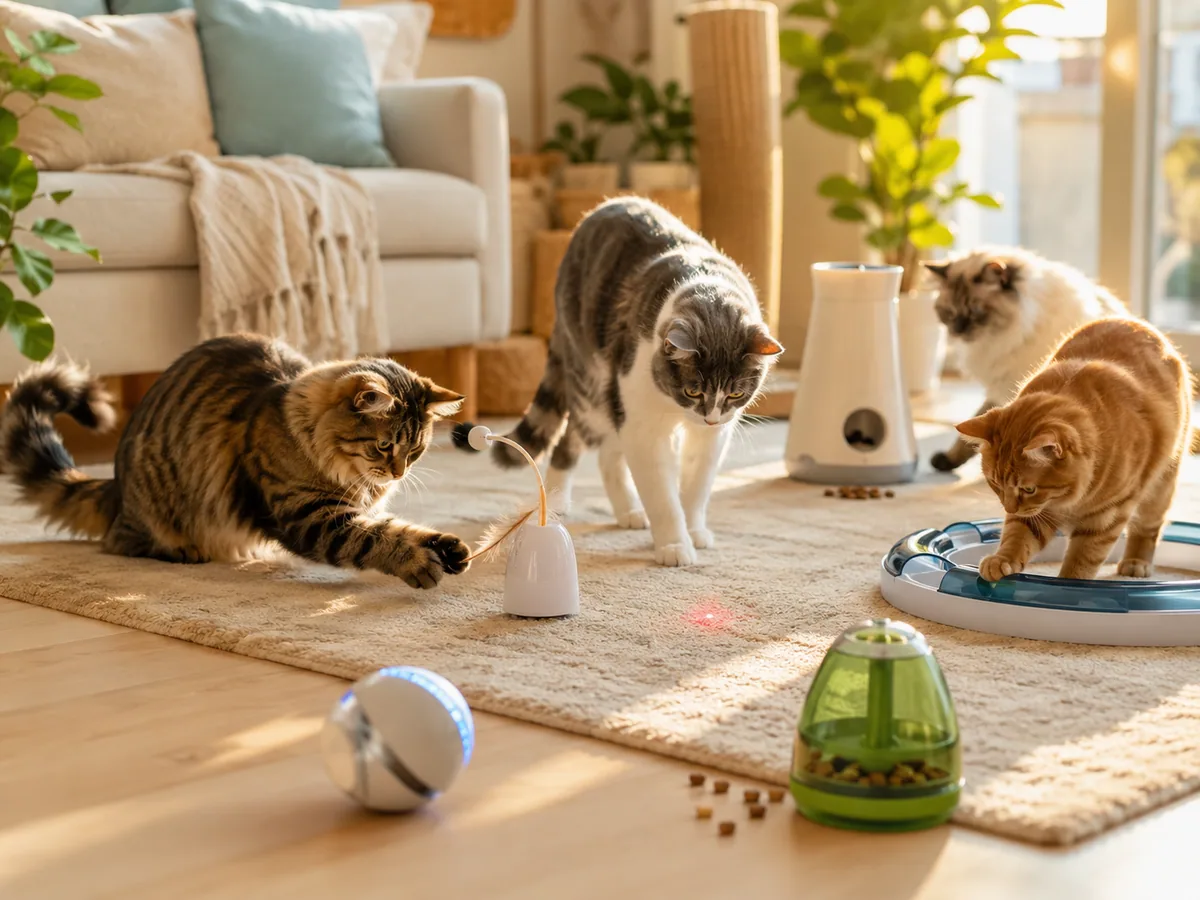
Choose the movement before choosing extra features
Watch how your cat responds to a familiar toy first. Does it follow a slowly rolling object, wait for something to emerge, or enjoy short bursts of movement followed by pauses? Use that observation to narrow the mechanism. Faster movement is not automatically more engaging, and constant spinning can be less useful than a target that your cat can comfortably intercept.
International Cat Care's guidance on playing with your cat identifies noise, movement, location, and the presence of other cats as factors in toy preference. It also recommends adapting games to mobility. For a cat that plays while lying down, a reachable, slower target may be a better starting point than a ball that races away. Ask your veterinarian about suitable activity if pain or mobility problems are a concern.
Check whether sounds and lights can be disabled independently of movement. Motor hum, hard-shell rattling, and impacts against furniture are different noises; a quiet-motor claim does not describe them all. Look for a demonstration with original audio rather than music, then judge the sound in your own room during a supervised trial.
Timed movement may mean a fixed run followed by sleep, repeated cycles, or activation after a tap. Read the instructions to distinguish them. A touch-triggered toy can restart when a cat investigates it. Avoid placing a restarting device beside a sleeping spot or across the cat's route to food or the litter box.
Check the surface and where the toy can travel
Surface compatibility matters particularly for rolling balls. Carpet pile, rug edges, and floor transitions can change how a particular mechanism moves. A demonstration on smooth tile is not evidence that the same ball will travel through your thick rug. Look for explicit surface guidance and a return policy rather than treating an all-floor advertisement as a guarantee.
Try the toy in the intended room before letting your cat approach. Observe whether it stalls, slides, hits furniture repeatedly, or enters gaps you cannot easily reach. If the motor keeps trying to move a trapped toy, switch it off and follow the manufacturer's instructions. Do not modify the mechanism or force it through an unsuitable surface.
Keep powered floor toys away from stairs, balconies, water bowls, loose cables, and unstable objects. For a rotating base, check that it stays upright on the chosen surface and that a rug or cover cannot bunch into moving parts. Leave your cat an unobstructed route away from the game.
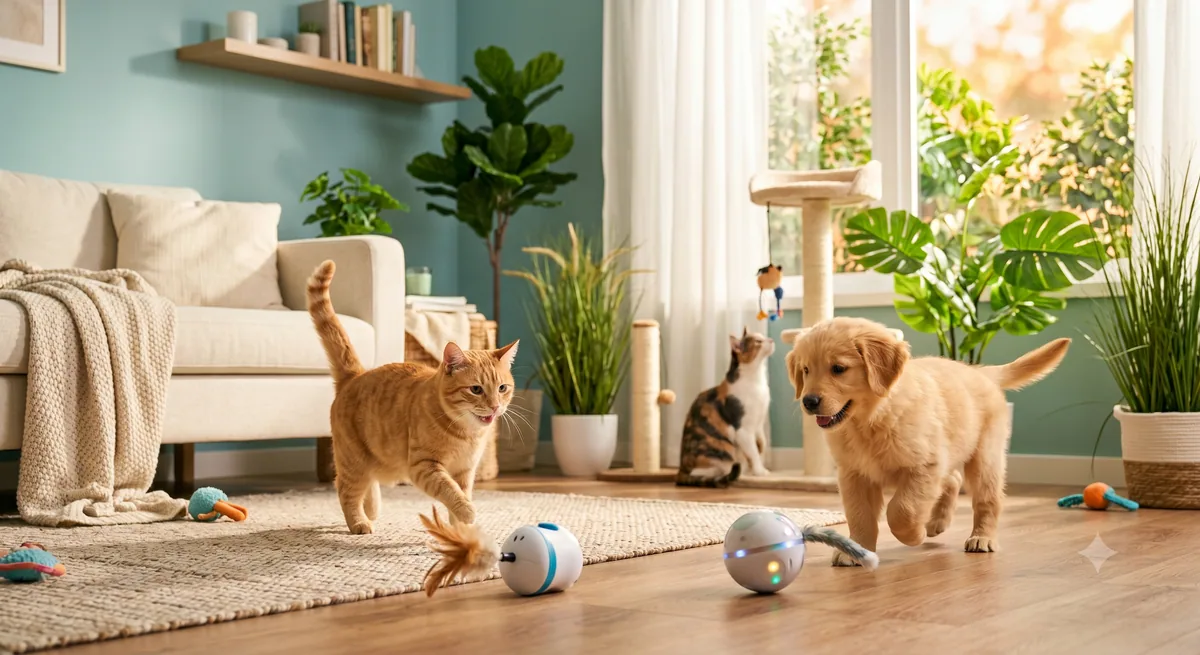
In a household with other pets, start with one cat in a quiet area. A dog may carry off the toy, and another cat may block access. Separate trials let you see whether the mechanism interests each cat without competition obscuring the result.
Inspect batteries, charging, and the off switch
Compare replaceable-battery and rechargeable designs by the handling they require. Replaceable cells mean opening and resecuring a compartment. A rechargeable toy still needs an intact housing, compatible charging equipment, and storage away from the cat while charging. Neither power system is automatically safer or more durable.
Check that the battery compartment closes securely and that its fasteners and cover are intact. Reject a toy with a missing screw, cracked latch, exposed cell, or a cover that opens during normal handling. Keep spare and used batteries out of reach. Pet Poison Helpline's battery guidance warns that chewing or swallowing batteries can cause serious injury. Suspected battery exposure needs prompt veterinary advice, not another trial to see whether the toy works.
Follow the manufacturer's battery type, polarity, charging method, and storage instructions. Do not improvise with different cells or chargers. Keep the charging cable inaccessible and disconnect it before play. Do not offer a toy with swelling, leakage, unusual heat, or a damaged charging port; contact the supplier about appropriate handling or disposal.
An advertised battery-life figure may refer to standby rather than continuous movement. Check what the claim measures, whether the toy needs manual restarting, and whether speed or sound modes affect operation. If the seller provides no clear instructions, that uncertainty is a reason to choose a better-documented design.
A useful control is an off switch you can operate immediately. Test it without the cat present. Then observe a complete automatic cycle: does the toy stop, sleep, or later restart? Auto-shutoff limits a run but does not prevent chewing, detached parts, or entanglement. Do not use a timer as a substitute for supervision.
Run a short trial you can interrupt
Introduce the toy switched off so your cat can investigate or ignore it. Start movement at a distance on the lowest suitable setting, with yourself close enough to turn it off. Do not place the cat beside it, hold the cat there, or push a moving target toward its face. Let the cat decide whether to approach.
Watch both the cat and the mechanism. Stalking, batting, and returning after a pause can tell you more than the number of minutes the motor runs. Backing away repeatedly, hiding, hissing, or trying to escape are reasons to stop, not to increase the speed. A cat that simply watches may need a different movement pattern or may prefer another toy.
Keep the first trial brief and finish when your cat loses interest or appears uncomfortable. There is no universal session length for an automatic device. VCA's Play and Play Toys guidance recommends monitoring cats during play, adjusting sessions to their interest, and using targets they can catch. If a powered lure keeps escaping, switch it off and offer an appropriate physical toy to finish with.
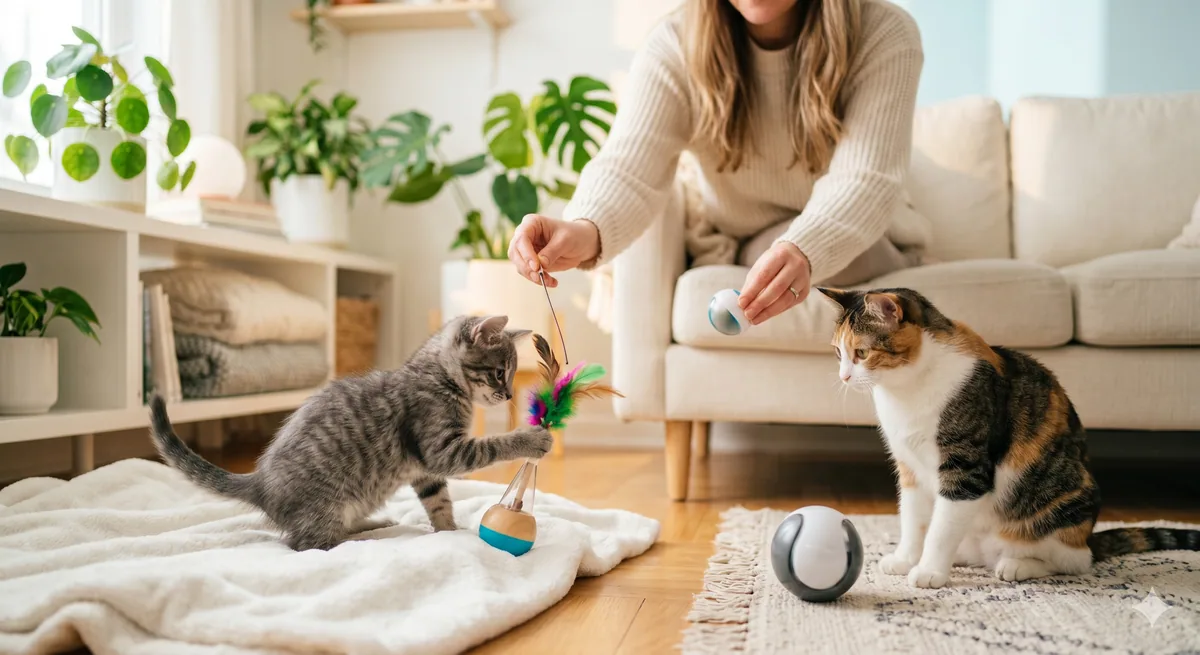
Repeat only if the housing and attachments remain intact. Change one setting at a time so you can identify what helps. Success means a manageable game your cat chooses to join, not exhausting the cat or leaving the motor running. Stop using the device if the cat concentrates on chewing its casing or pulling apart the mechanism.
Inspect after play and decide when not to use it
With the toy switched off, inspect the casing, seams, attachments, cover, battery door, and charging port before the next session. Look for bite marks, cracked plastic, loosened fasteners, frayed material, or missing pieces. Check beneath a concealed-motion cover according to the instructions. A damaged attachment should not remain in use merely because the motor still runs.
Oregon Humane Society's Safe and Fun Cat Toys guide cautions against ribbons, strings, feathers, and small parts that can be chewed off or swallowed. On a powered toy, do not assume that movement makes these attachments less accessible. Remove the toy from use if an attachment becomes loose, and use only replacements approved for that design.
Clean removable components as directed, keeping liquid away from electrical parts. Clear hair from accessible areas only as the instructions allow and never while the toy is running. Store the device switched off and out of reach, especially if it has a dangling lure. Check again after cleaning or replacing an attachment.
Automatic movement does not mean unattended safety. A supervised trial can reveal problems, but it cannot prove that a device will remain suitable when nobody can intervene. Our guide to toys for cats home alone covers the separate question of planning activities during an absence. Do not infer that every electronic toy is appropriate simply because it has a sleep mode.
Skip a powered device if your cat persistently avoids it, dismantles toys, or cannot comfortably follow its movement. Ask your veterinarian for individual guidance when health limitations or swallowing behavior complicate the choice. Keep playing together with suitable nonpowered toys too; a motor cannot respond to your cat's signals as you can.
Frequently asked questions about automatic cat toys
Are automatic cat toys safe to leave on when I go out?
Do not assume they are. A timer does not remove risks from chewing, loose attachments, batteries, or a trapped mechanism. Follow the manufacturer's supervision instructions and your veterinarian's advice for your cat. This guide recommends supervised powered play, not leaving an electronic toy running during an absence.
Do motorized cat balls work on carpet?
Some designs can move on certain carpets, while others need smoother surfaces. Check the stated compatibility and test the exact carpet without your cat first. If the ball stalls at pile or rug edges, switch it off rather than assuming it will free itself.
What should I choose for a cat frightened by motor noise?
Start with a nonpowered toy your cat already accepts. If you later try a powered option, look for controllable speed and optional sound, introduce it switched off, and keep the first movement distant and brief. Stop if the cat retreats or hides; do not force repeated exposure.
Is a concealed-motion toy safer than a rolling ball?
Not necessarily. It keeps movement in one area, but a cat may lift, chew, or snag the cover and reach an attachment. Compare the actual construction, accessible parts, controls, and your cat's behavior rather than treating either mechanism as inherently safe.
How do I know whether an automatic toy is a good match?
Look for voluntary approaches, comfortable movement, and opportunities to bat or catch the target during supervised trials. The toy should also operate properly on your floor and remain intact. If your cat ignores it, fears it, or dismantles it, choose a different mechanism or a nonpowered alternative.
Build a supervised play setup
Explore the cat shop for complementary play options. Check each product's mechanism and instructions rather than assuming a listing is an automatic toy. Keep wand play as a separate supervised activity.
Shop cat wand toys →