This page covers choosing toys and planning play for an American Toy Fox Terrier, not choosing or buying the dog itself. Start with the individual dog's size, preferences, chewing behavior, and health. The suggestions below are general activity options, not results of first-hand product testing or a guarantee of safety.
Quick Answer: How Should You Choose Toys?
For an American Toy Fox Terrier, choose play equipment for the individual dog rather than the breed name on a label. Check size, detachable parts, cleaning instructions, and damage. Introduce toys under supervision, and keep shared play and suitable exercise in the routine. Humane World: choosing safer dog toys.
Why Do Suitable Toys and Shared Play Matter?
Answer: Suitable play can provide activities for a dog's mind and body. The ASPCA includes food puzzles, walking, training, and shared games in its advice on destructive chewing. Toys are not a guaranteed way to prevent behavior problems, and persistent changes deserve veterinary advice. ASPCA: destructive chewing.
The ASPCA identifies a lack of physical and mental stimulation as a possible contributor to destructive chewing. Consider suitable walks, training, shared games, and food activities together. A Toy Fox Terrier's breed name does not establish a fixed exercise requirement or tell you which toy it will prefer. ASPCA: physical and mental activities.
Chewing is normal behavior, but a chew toy should not be presented as a substitute for dental care or as proven to remove plaque. Discuss appropriate chewing materials and your dog's teeth with a veterinarian. The ASPCA warns that intense chewing on natural bones can chip teeth or break off pieces. ASPCA: chewing precautions.
Include active time together rather than relying entirely on objects left around the home. Humane World recommends interactive play such as fetch and finding toys or treats. Choose games that fit your dog and your available space, without promising that a product will reduce anxiety. Humane World: interactive play.
Which Toy Types Could Suit an American Toy Fox Terrier?
Answer: Compare carrying toys, supervised chew toys, food puzzles, and equipment for shared games. None is essential for every dog, and no material is universally safe. Pick a size that cannot be swallowed and stop play when an item tears or breaks apart. Humane World: dog toys.
A chew toy may give your Toy Fox Terrier an appropriate item to investigate with its mouth. That does not make every rubber, nylon, or natural product suitable. Inspect its construction and ask your veterinarian about choices if your dog has damaged teeth or breaks pieces from toys. ASPCA: chewing precautions.
If you want even more options, check out our guide to teacup poodle.
A suitable food puzzle can be an activity option. The ASPCA suggests including part of a dog's daily ration in the toy. Introduce it while you can watch, and adjust the setup to the individual dog. Do not assume a puzzle will occupy a particular amount of time or resolve distress. ASPCA: food puzzles.
Fetch and tug are ways to share play when the equipment and activity suit your dog. Choose an appropriately sized ball or tug item and stop if it is damaged. Humane World notes that tennis balls are for fetching rather than prolonged chewing and should be discarded if chewed through. Humane World: fetch and tug toys.
Some dogs carry or rest beside soft toys, while others tear them apart. Humane World cautions that stuffed toys are not appropriate for every dog and that even safe-labelled stuffing is not digestible. Supervise play and remove loose pieces, ribbons, eyes, or exposed stuffing. Humane World: soft-toy precautions.
What Should You Check Before Play?
Answer: Size matters, but it is not the only safety factor. Humane World advises choosing a toy that cannot be swallowed or lodge in the throat, removing detachable parts, supervising squeaky-toy play, and discarding damaged items. The dog's behavior and the play environment also matter. Humane World: toy safety.
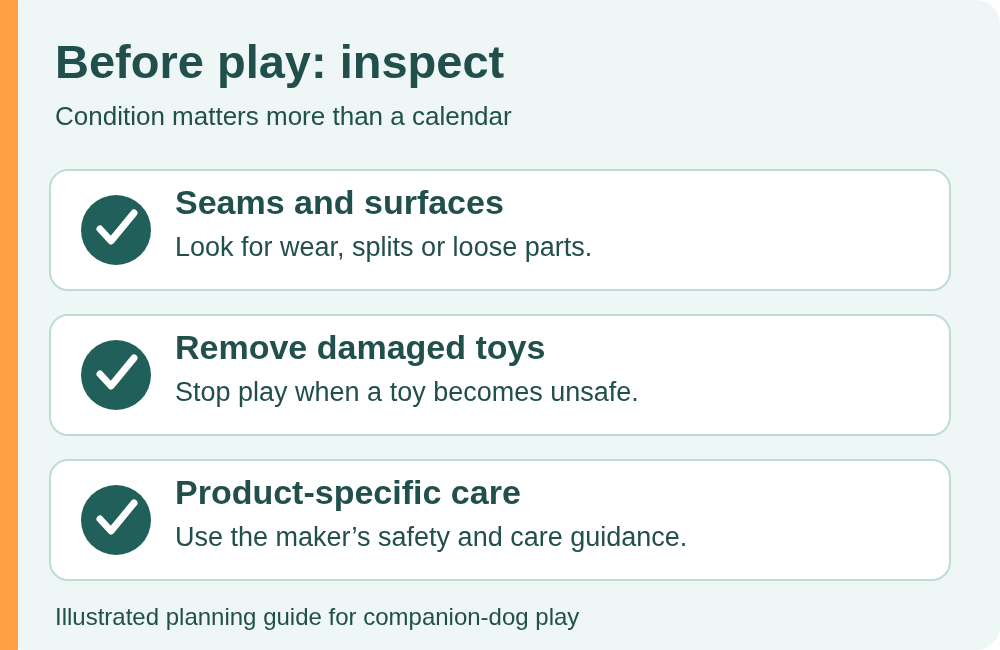
Choose a toy that cannot be swallowed or lodge in your dog's throat. Recheck it during use because damage can create smaller pieces. A small dog still needs appropriately sized equipment; a product advertised for small breeds is not automatically suitable for every Toy Fox Terrier. Humane World: toy size.
A material label is not a safety certification for your individual dog. Look for detachable parts and consider how the dog chews the item. Humane World warns about swallowed strings, ribbons, eyes, and stuffing. Stop using a toy that is being dismantled rather than played with. Humane World: detachable parts.
Inspect toys before play and remove those that tear, break, or lose parts. Inspection reduces avoidable risks but cannot guarantee that an accident will not happen. Contact your veterinarian promptly if you think your dog has swallowed a toy part, rather than waiting for the next planned check. Humane World: discard damaged toys.
How Should Health and Life Stage Shape Play?
Answer: Choose activities for your dog's current health and behavior, not a fixed age cutoff. Puppy teething, dental problems, or reduced mobility may change what is appropriate. Ask your veterinarian about suitable materials and exercise if you are unsure, and supervise the introduction of any new item.
A puppy needs suitable items to chew and guidance about what belongs to it. Ask your veterinarian which products suit its teeth and chewing behavior. Do not assume a frozen toy, hard chew, or product labelled for puppies is automatically safe. ASPCA: puppy chewing.
You might also enjoy our recommendations for toy fox terrier.
For an adult Toy Fox Terrier, watch how the individual uses a toy. Some dogs carry it gently; others try to pull pieces off. Match the equipment and supervision to that behavior, not to a claim that every adult dog has the same jaw strength or energy level. Humane World: individual safety factors.
Changes in mobility, comfort, or dental health can affect play at any age. If your dog becomes reluctant to carry a toy or take part in a familiar game, ask your veterinarian rather than assuming it is simply getting older. Keep activities accessible and stop when the dog needs a break.
How Can You Organize Toys and Shared Activities?
Answer: For a Toy Fox Terrier, begin with a manageable selection of suitable toys and watch which activities the individual dog enjoys. Store spare items safely and rotate them when interest changes, checking for damage before reuse. This is a practical way to organize play, not a fixed formula that guarantees engagement or replaces time together.
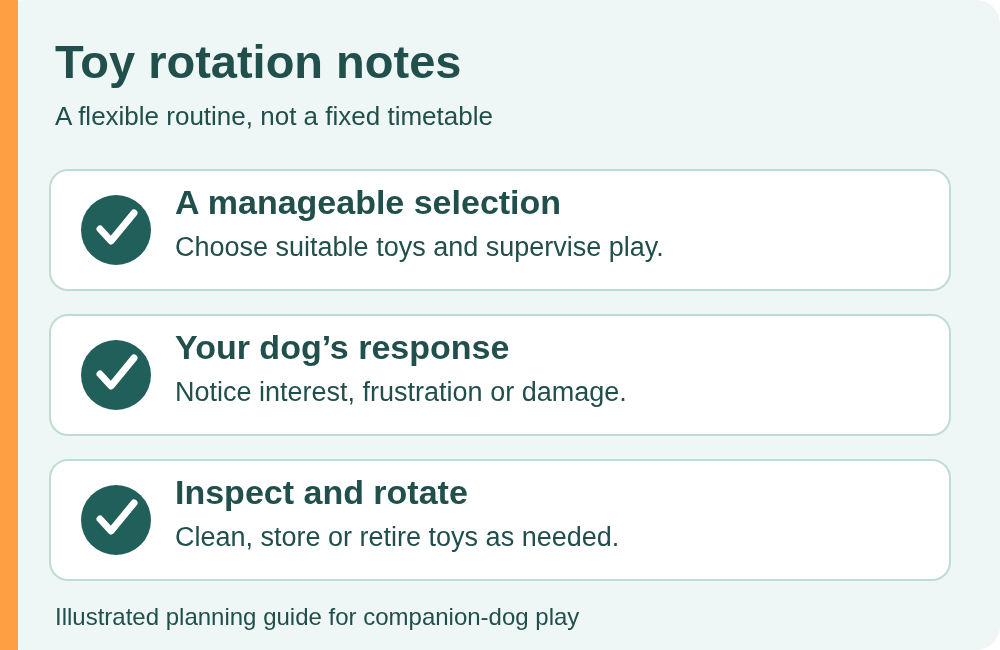
For a Toy Fox Terrier, begin with a manageable selection of suitable toys and watch which activities the individual dog enjoys. Store spare items safely and rotate them when interest changes, checking for damage before reuse. Treat the arrangement as something to adjust, not a proven optimum for every dog. Familiar toys may become interesting again, but the response varies with the individual and the activity.
Food-based activities can be part of play when the food, toy, and difficulty are suitable for the individual dog. Follow manufacturer instructions for any stuffable toy and check ingredients before using a filling. Introduce food puzzles under supervision, account for treats within the daily diet, and stop if your dog chews the equipment. Compare your dog's response without promising that food enrichment lasts longer than other play.
Make time for shared play instead of relying on toys as passive entertainment. Choose activities that suit your Toy Fox Terrier's health, preferences, and comfort, and end a session when your dog needs a break. Observe how the routine affects the individual rather than claiming a fixed dose of play will improve behavior or sleep. Ask for professional advice if you see persistent distress or difficulty settling.
Which Toy-Selection Mistakes Should You Avoid?
Answer: Do not let appearance, price, or a durability slogan replace checks of size and construction. Observe how your dog uses each item, supervise squeaky and stuffed toys, and discard damaged pieces. Humane World explicitly says it cannot guarantee the safety of any specific toy. Humane World: toy precautions.
An appealing design does not show how a toy will behave when chewed. Check for loose seams, detachable decoration, and a size that could be swallowed. Treat a product review as information about another dog, not proof that the same item is safe for yours. Humane World: choosing dog toys.
For related picks, take a look at our mini miniature poodle roundup.
A large pile of toys can make it harder for an owner to notice which items their dog actually uses. Put spare items away safely and offer a manageable variety of suitable activities. Watch your Toy Fox Terrier's choices, check toys for wear, and adjust the selection when needed. This is an organization strategy, not a demonstrated psychological rule or a guaranteed way to increase interest.
Neglecting to supervise initial play sessions with new toys creates unnecessary risk. Every dog interacts with toys differently, and you cannot predict how yours will respond to an unfamiliar product. Watch your dog closely during the first few play sessions with any new toy, paying attention to whether they try to tear it apart, swallow pieces, or show frustration.
How Should You Compare Toy Costs and Instructions?
Answer: Cost alone does not establish whether a toy suits your dog. Compare its size, construction, cleaning instructions, and intended use with your Toy Fox Terrier's play style. Look at reviews cautiously and inspect the actual item before use. Choose within your budget, supervise the introduction, and retire damaged toys rather than assuming a higher or lower price guarantees quality.
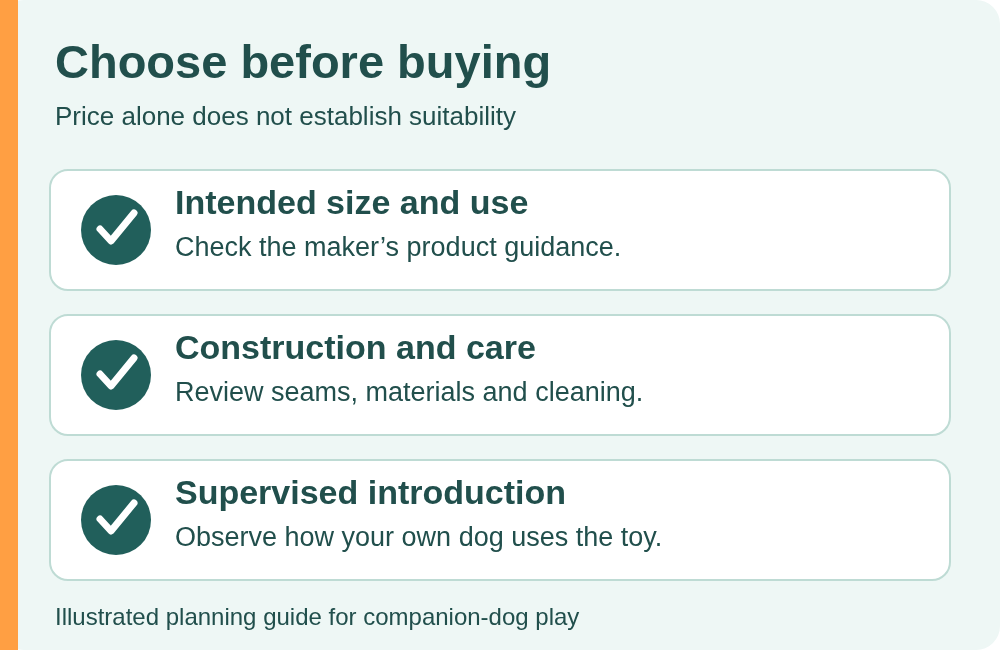
Cost alone does not establish whether a toy suits your dog. Compare its size, construction, cleaning instructions, and intended use with your Toy Fox Terrier's play style. Look at reviews cautiously and inspect the actual item before use. Choose within your budget, supervise the introduction, and retire damaged toys rather than assuming a higher or lower price guarantees quality.
A toy with several intended uses may be convenient, but versatility is not evidence of value or safety. Follow the maker's instructions for each use, including filling and washing. Decide whether the functions actually suit your dog before comparing prices.
Heavy or bulky items like rope toys and rubber chews can carry significant shipping costs. When comparing prices, factor in delivery fees so you can evaluate the true total cost across retailers.
How Should You Compare Toys for an American Toy Fox Terrier?
Answer: These are general selection criteria, not tested product rankings. Compare size, intended use, construction, and care instructions, and ask your veterinarian about health-related concerns. We have not established a guaranteed runtime, lifespan, or safety certification for the suggestions on this page.
This guide does not report first-hand product trials. Product names and types are examples to consider, not evidence that a toy has passed an independent test. Inspect the actual item and monitor your dog's response before deciding whether to keep using it.
No toy is indestructible. A strong-chewing dog may damage rubber as well as soft materials, so examine the item during use and remove it when pieces become loose. Ask your veterinarian about appropriate options if your dog chips teeth or repeatedly swallows fragments. ASPCA: chewing precautions.
Treat-dispensing puzzles can offer a food-search activity for a Toy Fox Terrier when the size, materials, and difficulty are appropriate. Begin with an accessible design, show how it works, and observe your dog's comfort and interest. Adjust the challenge gradually rather than aiming for a stated engagement duration. Include food rewards within the daily diet and supervise to prevent chewing or swallowing toy parts.
What Belongs on a Toy Buying Checklist?
Answer: Compare actual product instructions rather than assuming that a higher price tier means safer materials. The checklist below is a buying aid, not measured product data or certification. Suitable size, supervision, and condition matter across price ranges.
Use the checklist below when examining a product. Ask the seller to substantiate any certification and follow the actual care label. A higher price alone does not show that an item is better suited to your dog.
| Check | What to confirm |
|---|---|
| Size | Cannot be swallowed or lodge in the throat |
| Condition | No torn sections, loose parts, or exposed stuffing |
| Intended use | Matches the manufacturer instructions and your dog's behavior |
| Care | Follow the actual cleaning label; do not assume dishwasher safety |
For detailed precautions, read Humane World for Animals on safer toy selection and ASPCA guidance on destructive chewing. These are general guidance, not certification of a particular product.
What Do Owners Ask About Toys and Play?
Answer: Choose toys for your individual Toy Fox Terrier, inspect them for damage, and supervise play. Toys can offer an activity but cannot guarantee a fixed behavioral result. Persistent distress or changes in chewing deserve veterinary advice.
What are the safest dog toys?
There is no material that makes a toy safe for every dog. Choose an appropriate size, remove detachable parts, supervise use, and discard damaged items. Humane World notes that safety depends on the dog and environment and cannot be guaranteed for any particular toy. Humane World: safer toy selection.
How often should I replace my dog's toys?
Inspect toys regularly and before play, following the manufacturer's care instructions. Replace an item when it develops cracks, tears, loose pieces, exposed stuffing, or sharp edges. Useful life varies with the product and how an individual dog uses it, so do not rely on a calendar estimate for rubber or plush toys. Remove a damaged toy promptly, even if it has only recently been purchased.
How many toys does a dog need?
The right selection depends on your individual Toy Fox Terrier, the available space, and the activities you can supervise. Offer suitable choices for chewing, food searches, or shared play without treating a particular inventory size as a proven optimum. Rotate according to your dog's response, keep spare items safe and clean, and inspect everything before reuse. No collection size guarantees novelty or engagement.
Are squeaky toys bad for dogs?
Squeaky toys are not inherently bad, but they require appropriate supervision. The squeaker mechanism inside can be a choking hazard if your dog manages to extract it. Choose squeaky toys with reinforced stitching and deeply embedded squeakers. Remove the toy immediately if your dog starts tearing it apart to reach the squeaker inside.
Can dog toys help with anxiety?
Toys can provide an activity, but they are not a universal treatment for anxiety. The ASPCA discusses food activities for some mild separation-anxiety cases and recommends professional help for more complex cases. Speak with your veterinarian about persistent distress. ASPCA: separation anxiety.
What toys are best for aggressive chewers?
Ask your veterinarian about suitable options if your dog damages toys or has dental problems. No durability label guarantees that an item cannot break. Monitor use and remove loose pieces; avoid assuming that a chew-proof warranty is a safety assessment. ASPCA: chewing precautions.
Should I let my dog play with tennis balls?
Tennis balls are generally safe for supervised fetch but should not be used as chew toys. The fuzzy exterior acts like sandpaper on tooth enamel during extended chewing sessions, wearing down teeth over time. The ball itself can also compress in a large dog's jaws and become a choking hazard. Use tennis balls for fetch only, and switch to rubber balls for chewing.