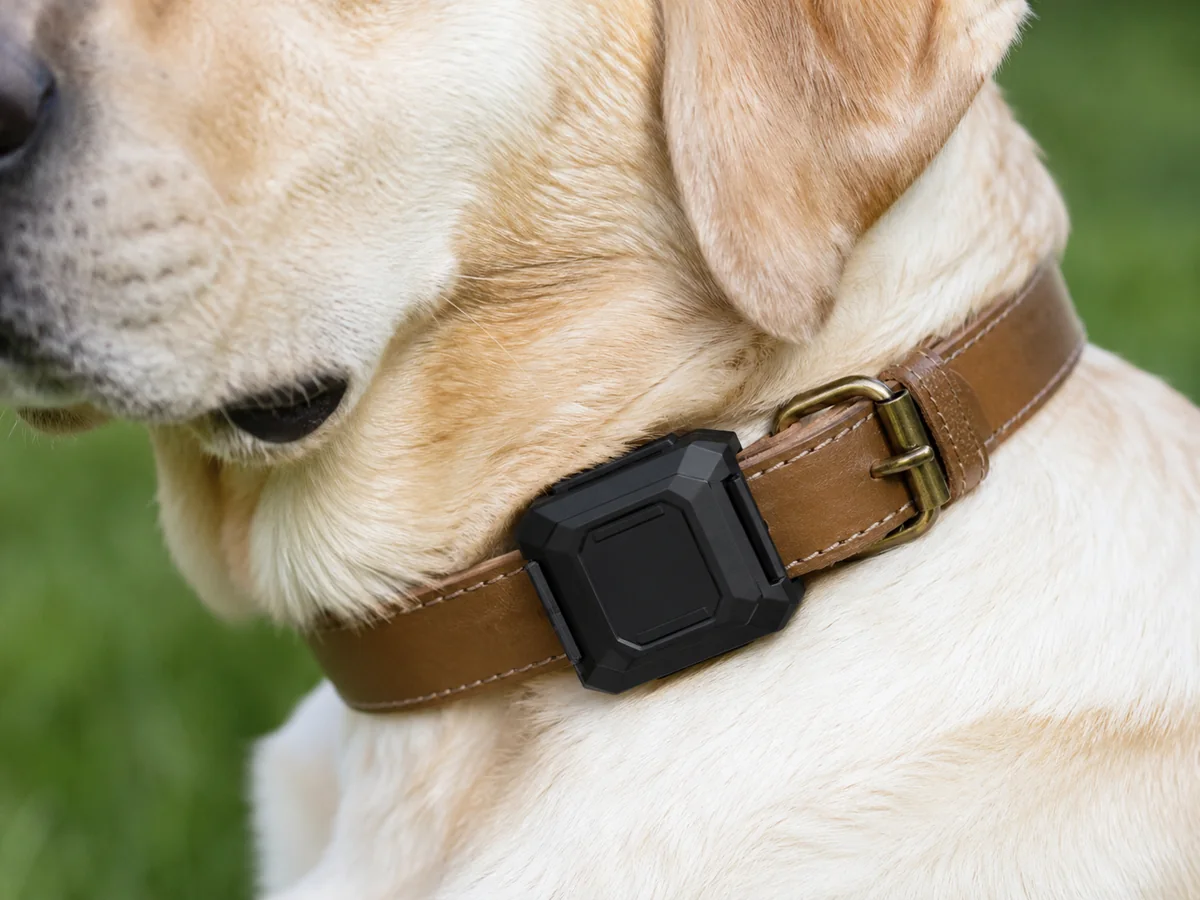
A GPS tracking device for dogs is a small unit that attaches to your dog's collar, works out where it is from satellite signals, and sends that position to an app on your phone. It answers a question no other pet product answers: where is my dog right now. That is a genuinely different job from the one a microchip does, and confusing the two is the most common and most expensive mistake owners make in this category.
This guide explains how these devices work, how a tracker differs from a microchip and an ID tag, which types exist and who each one suits, the features worth paying for, how the fit affects your dog's comfort and skin, what the subscription really costs across a year, and the situations where a tracker will quietly let you down. The goal is a buying decision you can defend, not a ranked list of brands.
What a GPS tracking device for dogs actually does
Two separate things happen inside the unit on your dog's collar. First, a GPS receiver listens for signals from navigation satellites and calculates its own position from them. Second, a radio of some kind sends that position somewhere you can see it. Those two jobs are worth separating in your head, because almost every practical limitation of these devices traces back to one or the other.
Most consumer dog trackers use a cellular connection for the second job. The device carries a small SIM and reports its position over the mobile network, which is why the vast majority of them require an ongoing subscription. That subscription is not a marketing add-on, it is the cost of the airtime. A device that reports over cellular can update your map from anywhere with coverage, which is exactly what you want when your dog is two fields away. It is also why coverage gaps matter so much, which we come back to below.
Refresh rate is the other half of the experience. Most trackers idle at a slow update interval to save battery, then switch to frequent updates when you open a live tracking mode. That switch is what turns a map showing where your dog was a few minutes ago into something you can actually follow on foot, and it is also what drains the battery fastest. Understanding this trade-off matters more than any headline battery figure on the box.
Tracker, microchip, and ID tag are three different tools
This is the single most important section on the page. The American Veterinary Medical Association is unambiguous in its microchipping FAQ for pet owners: a pet microchip is not a GPS device and cannot track your animal. A microchip is a tiny electronic device in a glass cylinder, about the size of a large grain of rice, with no internal power source. It stays inactive until a compatible scanner passes over it, at which point the scanner's radio waves activate the chip and it transmits a unique identification number, typically nine, ten, or fifteen digits long.
That design is a feature, not a shortcoming. A microchip needs no battery, cannot fall off, and cannot be removed by whoever finds your dog. It is how a shelter or veterinary clinic identifies your dog as yours after someone has already picked her up. But it only works if the chip is registered and your contact details are current, which the AVMA stresses repeatedly. If your phone number changed two years ago, the chip is a dead end.
The AVMA is equally clear that a microchip does not replace visible identification: microchips are excellent for permanent, tamperproof identification, but nothing replaces a collar with up-to-date identification tags. A neighbor who finds your dog in the street can read a tag in three seconds. Getting that tag right is its own small decision, and our dog tag buying guide covers the engraving and materials that survive daily wear.
| Tool | The question it answers | Needs power | Can be lost or removed |
|---|---|---|---|
| GPS tracker | Where is my dog right now? | Yes, needs charging | Yes, it is attached to the collar |
| Microchip | Who does this found dog belong to? | No, activated by a scanner | No, it is implanted |
| ID tag | Who do I call, right now, without a scanner? | No | Yes, it hangs from the collar |
The right answer is not to choose between them. It is to have all three, because each covers the exact gap the others leave open.
The main types of tracker and who each one suits
The category is less uniform than the marketing suggests. Four broad designs exist, and the differences between them decide whether a device is useful in your specific situation.
- Cellular GPS trackers. The mainstream option. Position from satellites, reporting over the mobile network, live tracking in an app, usually a monthly or annual subscription. Best for everyday use in towns, suburbs, and well-covered rural areas.
- Radio telemetry trackers. Common with hunting and working dogs. The collar unit talks directly to a handheld receiver over a radio link rather than a phone network, so it keeps working where there is no cell signal at all. In exchange you carry a dedicated handset, and you generally read direction and distance rather than a street map.
- Bluetooth tags. Small, cheap, no subscription, long battery life. These are proximity finders, not trackers. They tell you a tag is near your phone, or where another user's phone last detected it. For a dog running out of sight across open ground, that is not the tool.
- Containment collars with tracking built in. Devices that combine a virtual boundary with location reporting. Useful if you actually want boundary alerts, but the tracking features vary widely and the correction features raise separate welfare questions worth discussing with your trainer or veterinarian. Our review of one popular containment collar walks through those trade-offs.
If you are choosing between form factors rather than technologies, our companion guide to the GPS dog collar covers integrated collar designs where the electronics are built into the strap itself.
Features that genuinely matter
Spec sheets in this category are long and mostly noise. These are the specifications that change how the device performs on a bad day.
- Battery life at the update rate you will actually use. The quoted figure is almost always for idle mode. Ask what live tracking does to it. A device rated for days that lasts ninety minutes in live mode is still a usable device, but only if you know that before the day you need it.
- Water resistance. Dogs swim, roll in wet grass, and get bathed. Look for a stated ingress rating rather than the word "waterproof" on the packaging.
- Attachment security. The mount is the failure point. A tracker that pops off in undergrowth has told you exactly where your dog was when the bracket broke, which is not the same as where your dog is.
- Network coverage where you actually walk. Check the carrier the device uses against coverage at your regular walking spots, not just at home.
- Light and sound recall aids. A remote-triggered LED or beeper is genuinely useful for locating a dog in the dark once you are within a hundred metres.
- Alert quality. Boundary and low-battery alerts are only worth having if they arrive fast and do not fire constantly, since alerts you learn to ignore are worse than no alerts.
- App reliability and account handling. The app is the product. Check whether more than one family member can be logged in and see the dog at the same time.
Notice what is missing from that list: activity tracking, sleep scoring, and calorie estimates. They are pleasant extras, but they should never break a tie against battery life or attachment security.
Fit, weight, and wearing it safely
A tracker adds weight and a hard edge to something your dog wears all day, so fit stops being cosmetic. Use the standard two-finger rule: you should be able to slide two fingers flat between the collar and your dog's neck. Any looser and the collar can catch or slip over the head; any tighter and you are risking rubbing and restriction. If your collar has stretched, our guide to an adjustable dog collar covers getting that sizing right in the first place.
- Watch the weight ratio. Manufacturers publish a minimum dog weight for a reason. A unit that a labrador does not notice is a meaningful load on a five kilogram terrier.
- Position it off the throat. Let the device sit to the side or on top of the neck rather than pressing on the windpipe, and make sure it cannot slide down into that position on its own.
- Check the skin underneath. Any hard object worn continuously against skin can cause pressure rubbing, especially if it stays damp. Look at that patch during grooming, and take the collar off for part of the day when you are home. If you find a persistent lump or sore spot in that area, our guide to skin lumps and skin tags on dogs explains what warrants a veterinary look.
- Do not leave a tracker collar on in a crate unsupervised. Protruding hardware is a snag risk against bars and fabric.
- Keep visibility in mind. A tracker does nothing for the driver who cannot see your dog at dusk. Pair it with a reflective collar if you walk in low light.
What it really costs over a year
The sticker price is the smaller number. Because most cellular trackers need airtime, the honest comparison is total cost across the period you expect to own the device. Work it out before you buy rather than after the first renewal notice.
| Cost line | What to check |
|---|---|
| Hardware | Whether the advertised price assumes you also sign up for a plan |
| Subscription | Monthly versus annual pricing, and what the price becomes after any introductory period |
| Contract length | Whether you can cancel, and whether the device still does anything without a plan |
| Replacement parts | Cost and availability of the mount, strap, and charging cable, since these fail first |
| Battery replacement | Whether the battery is user replaceable or the whole unit is disposable when it degrades |
| Multi-pet pricing | Whether a second dog needs a second full-price plan |
One question is worth asking explicitly before you pay: what does this device do if I stop the subscription? For most cellular trackers the answer is that it becomes inert. That is not a scandal, but it should be a known fact rather than a surprise.
Setting it up so it works when it counts
A tracker that has never been tested is a guess. Spend twenty minutes on setup and you convert it into a tool.
- Charge it fully and learn the charge cycle. Pick a fixed time to top it up, such as during your dog's evening meal, so it never sits at five percent.
- Test it before you need it. Have someone walk the dog a few streets away while you follow on the app. You will learn the real refresh lag and how the map behaves.
- Test it in the awkward places too. Try the wooded part of your usual walk, the car park with the concrete deck, and anywhere you already know the phone signal is poor.
- Set up alerts deliberately. Draw boundaries where they genuinely mean something, and turn on the low battery warning.
- Add a second family member to the account. The person holding the leash is not always the person holding the right phone.
- Confirm your microchip registration on the same day. The AVMA notes that a microchip only does its job when it is registered with current contact details, so treat this as part of the same task rather than a separate one.
Finally, write your recall plan down while you are calm: who searches where, who stays at home, which neighbours to call, and which local shelters and veterinary practices to notify. That plan is worth more than any feature on the box.
What a tracker cannot do for you
Being clear about the failure modes is what separates a useful device from false confidence.
- It cannot report without power. A flat battery is an ordinary, predictable failure and the most common one.
- It cannot report without a signal. Cellular trackers go quiet in coverage gaps, and satellite reception itself degrades indoors, in dense urban canyons, and under heavy tree cover.
- It cannot stay attached to a collar that comes off. If the collar slips or the mount breaks, the device tracks the collar, not your dog.
- It cannot identify your dog to a stranger. Only a visible tag or a scanned microchip does that, which is precisely why the AVMA treats them as complementary rather than interchangeable.
- It cannot substitute for training and secure fencing. A tracker shortens a search. Reliable recall and a gate that latches prevent one.
Read that list as an argument for layering rather than an argument against trackers. A tracker plus a registered microchip plus a legible tag plus a well-fitted collar covers far more scenarios than any one of them alone.
Frequently asked questions
Does a microchip track my dog like a GPS device?
No. The American Veterinary Medical Association states plainly that a pet microchip is not a GPS device and cannot track your animal. A microchip has no internal power source and stays inactive until a compatible scanner passes over it, at which point it transmits only a unique identification number. It identifies your dog after someone finds her, while a GPS tracker shows you where your dog is right now.
Do GPS dog trackers need a monthly subscription?
Most cellular models do, because the device reports its position over a mobile network and that airtime has to be paid for. Radio telemetry trackers that talk directly to a handheld receiver usually do not need a plan, and Bluetooth tags do not either, though those are proximity finders rather than live trackers. Always check what the device still does if you stop paying.
How accurate is a GPS tracking device for dogs?
Accuracy varies with the conditions rather than being a single fixed number. Reception is best under open sky and degrades indoors, in dense urban areas, and under heavy tree cover. Refresh rate matters as much as raw accuracy, since a precise position from four minutes ago is less useful on foot than a rougher one updating every few seconds. Test yours on your actual walking routes.
Can my dog wear a GPS tracker all the time?
Many dogs do, but fit and supervision matter. Keep two fingers of room between the collar and the neck, position the unit off the windpipe, respect the manufacturer minimum weight for small dogs, and check the skin underneath during grooming. Remove tracker collars for unsupervised crate time, since protruding hardware can snag on bars or bedding.
Is a Bluetooth tag good enough for a dog?
Not for a dog that can get out of sight. Bluetooth tags report when they are near a phone, either yours or another user in the network, so they work reasonably for finding a collar dropped in the house or the car. A dog running across open ground moves out of Bluetooth range almost immediately, which is the exact scenario you bought the device for.
Should I get a tracker if my dog is already microchipped?
They solve different problems, so having one is not a reason to skip the other. The microchip proves ownership once your dog has been picked up and scanned, and the AVMA notes it works only if the registration details are current. The tracker is what shortens the gap between your dog going missing and being found. A visible ID tag covers the case where a neighbor finds her before anyone reaches a scanner.
What should I do first if my dog goes missing?
Open the tracker app and start live tracking immediately, then send someone to the last reported location while you keep watching for updates. Call your local shelters and veterinary practices, since that is where a found dog is scanned, and confirm your microchip registry has your current phone number. Search on foot near the last known point rather than driving, because dogs often stay closer than owners expect.
The bottom line for dog owners
A GPS tracking device for dogs is worth buying for one specific reason: it shortens the time between noticing your dog is gone and standing next to her again. Judge candidates on battery life at the refresh rate you will really use, on how securely the unit stays attached, and on whether the network works where you actually walk, rather than on activity dashboards. Then set it up properly, test it on a normal day, and treat it as one layer rather than the whole plan. Keep a legible ID tag on the collar and keep your microchip registration current, because as the AVMA puts it, a microchip is excellent permanent identification but nothing replaces a collar with up-to-date tags. Together those three cover the situations that any one of them would miss.